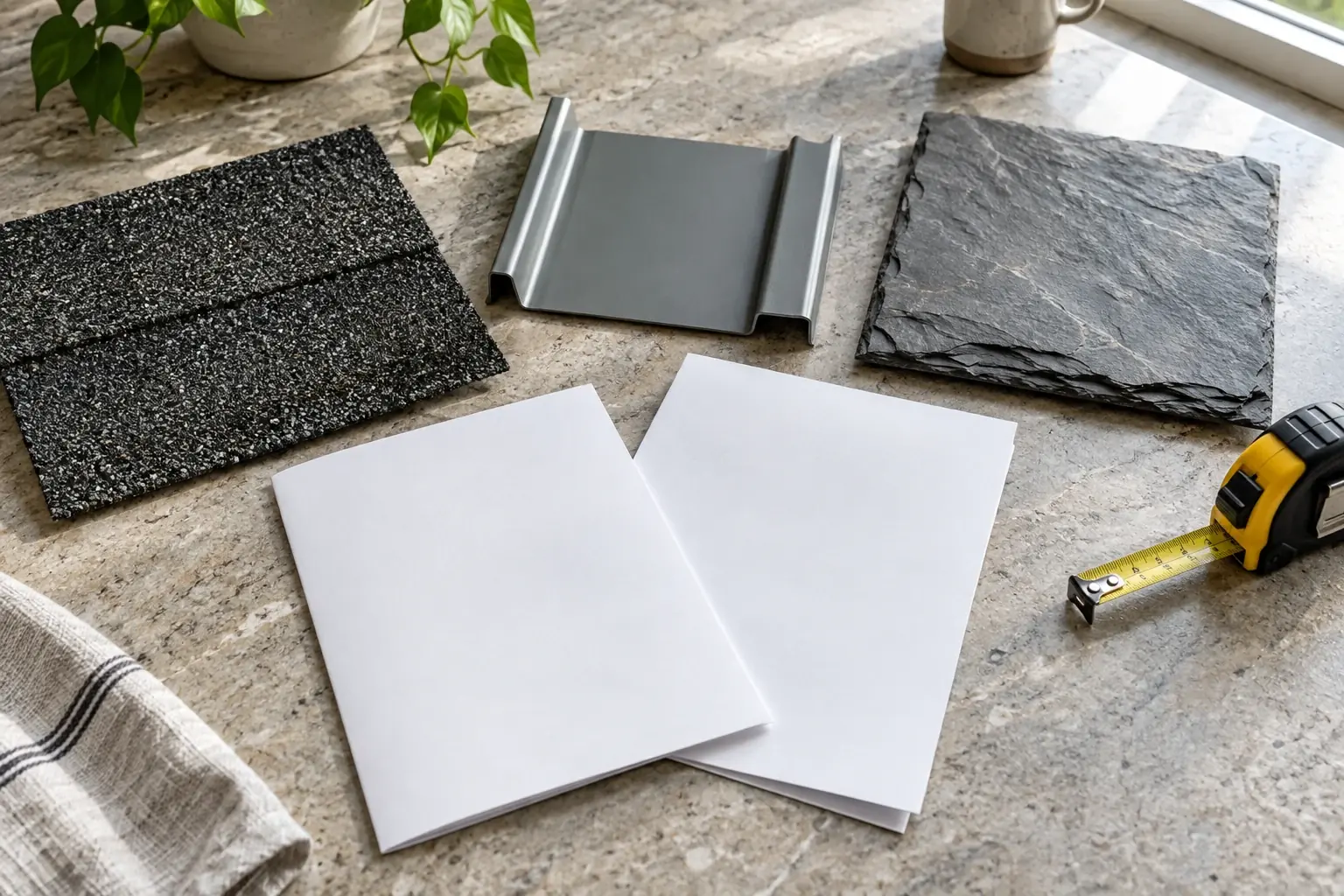
Why Do Roofing Quotes Differ So Much?
If two roofing quotes are $10,000 apart, do not compare the totals first. Compare the scope. In Northern Virginia, large gaps can come from different materials, tear-off assumptions, flashing and ventilation work, decking allowances, warranty coverage, labor models, insurance overhead, or simply items one contractor included and another left out.
Virginia DPOR advises homeowners to get written estimates from at least three contractors, not automatically choose the lowest bidder, and ask contractors to explain price differences between proposals. GAF gives similar guidance: roof cost changes with roof size, material, pitch, location, labor, permits, disposal, ventilation, warranties, and other scope details.
The result is simple: two contractors can look at the same house and still be pricing two different roofing projects. The lowest number is not automatically the best value, and the highest number is not automatically evidence of overpricing. Before choosing, turn all three quotes into the same scope.
For a closer look at what each estimate line should contain, read our guide on how to read a roofing estimate line by line.
Scope Differences Create the Biggest Quote Gaps
The first question should be: Are these contractors actually quoting the same job?
One proposal may include a complete tear-off, disposal, deck inspection, synthetic underlayment, leak-barrier membrane, new flashing, ventilation work, starter shingles, ridge caps, cleanup, and warranty registration. Another may simply say “remove and replace shingles.” Those descriptions may appear to cover the same roof, but financially they are not equivalent.
GAF recommends an itemized estimate and specifically says removal of old roofing material and cleanup should be included rather than appearing later as surprise costs. Its current cost guidance also says labor, permitting, disposal, ventilation products, underlayment, materials, and warranty options can all influence the final estimate.
Rain Guard Roofs follows the same scope-first approach on roof replacement in Northern Virginia: know what is being removed, what is being installed, and how concealed conditions will be handled before comparing the final number.
A Stripped Bid vs. a Complete Bid
Use this table to normalize competing proposals.
| Line item | Stripped bid may say | Complete bid should clarify |
|---|---|---|
| Roof measurement | “Roof replacement” | Measured roof area and quantities |
| Shingles | “Architectural shingles” | Manufacturer and exact product line |
| Tear-off | “Remove old roof” | Number of included layers and full removal scope |
| Disposal | Not mentioned | Dumpster/haul-away and disposal included |
| Underlayment | “Underlayment” | Specific product or type |
| Ice-and-water membrane | Not mentioned | Exact locations where installed |
| Flashing | “Reuse where possible” | Which flashing is replaced, rebuilt, or evaluated |
| Ventilation | Not mentioned | Existing and proposed intake/exhaust scope |
| Decking | “Extra if needed” | Defined unit price for replacement decking |
| Permits | Not mentioned | Included, excluded, or handled separately |
| Cleanup | “Jobsite cleanup” | Debris removal and final cleanup scope |
| Warranty | “Lifetime warranty” | Manufacturer and workmanship terms separately identified |
| Change orders | Not explained | What can change the price and how approval works |
| Payment | Deposit + balance | Written deposit and milestone schedule |
If one contractor prices most of the right-hand column and another prices only the left-hand column, the total difference does not tell you which contractor is expensive. It tells you the scopes are different.
Material Tier Changes More Than the Shingle Price
Homeowners often compare roofing bids by shingle brand or color alone, but material tier can affect multiple components. A proposal may use an entry-level shingle and basic compatible accessories. Another may use a different shingle line, upgraded underlayment, additional qualifying accessories, enhanced ridge products, or another system configuration.
GAF identifies roofing material as one of the most variable roof-cost factors and notes that warranty options can also depend on the combination of products installed and contractor qualification. That means “same brand” does not necessarily mean “same roof.” Ask for exact product names instead of descriptions such as “premium,” “architectural,” or “upgraded.”
The same principle applies to warranties. A proposal that includes broader manufacturer coverage may require a particular product combination or contractor eligibility. Do not compare a basic material warranty against enhanced coverage as if the two quotes contain the same protection. Our roofing warranties explained page is the better place to compare the actual documents.
In-House Crews vs. Subcontracted Crews
Crew structure can affect a roofing quote, but neither model is automatically good or bad. A contractor with employees may carry payroll, supervision, workers' compensation, vehicles, training, scheduling staff, and other direct operating costs. A contractor using subcontracted crews may structure those costs differently.
What matters to the homeowner is accountability. Ask who will actually install the roof, who supervises the project, who handles workmanship callbacks, and who is responsible if a subcontractor creates a problem.
Virginia's Workers' Compensation Commission makes an important point: a contractor cannot simply ignore workers' compensation because field labor is subcontracted. When determining coverage requirements, Virginia can count subcontractors' employees along with the contractor's own employees, and contractors can have statutory-employer responsibilities for subcontracted workers. So “we subcontract everything” should not be treated as proof that a contractor has no labor-related insurance obligations.
The useful distinction is not employee versus subcontractor. It is documented responsibility versus unclear responsibility.
Insurance-Related Work vs. a Cash Quote
Insurance-related roofing estimates can look different from direct homeowner quotes because the paperwork serves a different purpose. A direct cash estimate normally answers, “What construction work are you proposing, and what will it cost me?”
An insurance-related estimate may also need to separate damaged components, quantities, labor, materials, depreciation, and other line items so the property owner and insurer can evaluate the loss under the policy.
Virginia's State Corporation Commission explains that homeowners policies can treat replacement cost and actual cash value differently. Actual cash value generally accounts for depreciation, while replacement-cost policies may involve an initial ACV payment followed by additional payment after qualifying repair or replacement is completed, subject to policy terms and limits.
That does not mean a contractor should simply charge a different construction price because insurance is involved. It means you should compare the underlying construction scope.
Rain Guard Roofs' role on storm-related work is limited to the roofing side: inspect physical conditions, document what is visible, prepare a contractor estimate, and perform the approved construction scope. Coverage decisions remain between the property owner and insurer.
If one proposal is insurance-related and another is cash, normalize the materials and work before comparing totals.
Warranty Tier Can Change the Quote
“Warranty included” is not enough information. There may be a manufacturer material warranty, an enhanced manufacturer warranty, and contractor workmanship coverage. They are not interchangeable.
GAF confirms that enhanced manufacturer warranties have eligibility requirements and are available through qualifying certified contractors on qualifying systems. Different warranty levels can require different product combinations and coverage structures.
Rain Guard Roofs' exact GAF certification tier should not be assumed or published until verified, so a Rain Guard proposal should be evaluated by the actual written warranty documents supplied with that project.
When comparing quotes, ask each contractor to identify:
- The manufacturer warranty
- The workmanship warranty
- Any system or product requirements
- Exclusions
- Registration responsibilities
A verbal promise such as “lifetime warranty” is not enough.
Overhead and Insurance Are Part of the Price
Every contractor has overhead. The difference is what that overhead includes. A roofing company may be paying for field supervision, office administration, estimating software, vehicles, fuel, safety equipment, insurance, workers' compensation, licensing, training, project management, warranty service, waste handling, and other costs required to operate.
Those expenses do not automatically mean the highest-overhead contractor produces better roofs. But unusually low overhead can sometimes mean services or protections present in another quote are absent.
Virginia DPOR advises consumers to verify contractor licensing, use written contracts, and avoid automatically choosing the lowest bidder. State guidance also advises checking insurance credentials, while the Workers' Compensation Commission explains when contractors must maintain workers' compensation coverage.
A fair comparison therefore asks not simply, “Why is this company more expensive?” Ask instead, “What cost or responsibility is included here that is missing from the other proposal?” That question often explains the difference.
What a Suspiciously Low Roofing Bid Usually Leaves Unclear
A low price is not automatically suspicious. Efficient contractors, supplier relationships, smaller overhead, scheduling gaps, and different business models can produce legitimate differences. The warning sign is a low number combined with a vague scope.
GAF tells homeowners to be wary of an estimate that looks too good to be true and to check whether roofing materials or other expenses are missing. DPOR similarly says not to automatically select the lowest bidder and to ask contractors to explain price variations.
The biggest omissions to check are:
- Tear-off limits and disposal
- Product names, underlayment, and leak barrier
- Flashing and ventilation
- Decking pricing
- Permit responsibility and cleanup
- Warranty terms and change-order rules
Decking deserves special attention. No contractor can see every concealed sheet before tear-off. The honest solution is not an unlimited “wood extra” clause. A better estimate establishes a unit price before work begins, so concealed damage has a known pricing method if it is found.
That is one of the easiest ways to distinguish a complete quote from a low starting number that can grow after the roof is open.
How to Compare Three Roofing Quotes Fairly
Start by ignoring the bottom-line totals. Create one comparison sheet and write the exact product, tear-off scope, underlayment, leak-barrier locations, flashing, ventilation, decking unit price, cleanup, warranty, and payment terms from each proposal.
Mark any blank item as not specified, not “probably included.” Then ask each contractor to clarify the blanks in writing. Virginia DPOR recommends obtaining at least three written estimates and specifically advises consumers to ask for explanations when prices vary.
Once all three proposals contain roughly the same construction scope, compare the numbers again. Only then can you tell whether the higher contractor is genuinely charging more for the same work—or whether the lower contractor was simply quoting less work.
If financing is part of your decision, establish the actual roof scope before comparing payment options. Rain Guard Roofs takes that approach on its roof financing options page: define the project first, then decide how to pay for it.
Roofing Quote FAQs
Why can two roofing quotes be thousands of dollars apart?
Because the contractors may not be pricing the same scope. Differences can include roof measurements, material tier, tear-off, disposal, underlayment, flashing, ventilation, decking allowances, warranty coverage, crew structure, permits, insurance costs, and cleanup. Compare each line before assuming one contractor is simply charging more.
Does a more expensive roofing quote mean better quality?
No. Price alone does not prove quality. A higher proposal may include a more complete scope, upgraded products, broader warranty coverage, additional flashing or ventilation work, or higher operating costs. It may also simply be expensive. Normalize the scope first, then compare contractor qualifications, documentation, responsibility, and price.
Should an insurance roof quote and a cash quote be the same?
The construction scope should be comparable when the same work and materials are being proposed, but the documents may be structured differently. Insurance-related estimates can include additional line-item documentation connected to the claim process. Coverage, depreciation, and payment decisions belong to the owner and insurer; the contractor's role is to price the construction work.
How do I know whether a low roofing quote is missing something?
Compare it line by line with the other proposals. Check product names, tear-off, disposal, underlayment, leak barriers, flashing, ventilation, decking unit pricing, permits, cleanup, warranty terms, and change-order language. If major items are absent or described only as “as needed,” ask for clarification in writing before signing.
Compare the Roof, Not Just the Number
If your roofing quotes are far apart, Rain Guard Roofs can inspect the roof, document the visible conditions, and prepare a written scope so you can see exactly what is being priced.
Call Rain Guard Roofs at (571) 867-1776 or book your free inspection to discuss a roofing project in Northern Virginia.
Keep planning
Related roofing guides

Estimate guide
How to Read a Roofing Estimate
Compare the specific line items and assumptions behind a roofing proposal.Read the guide
Cost guide