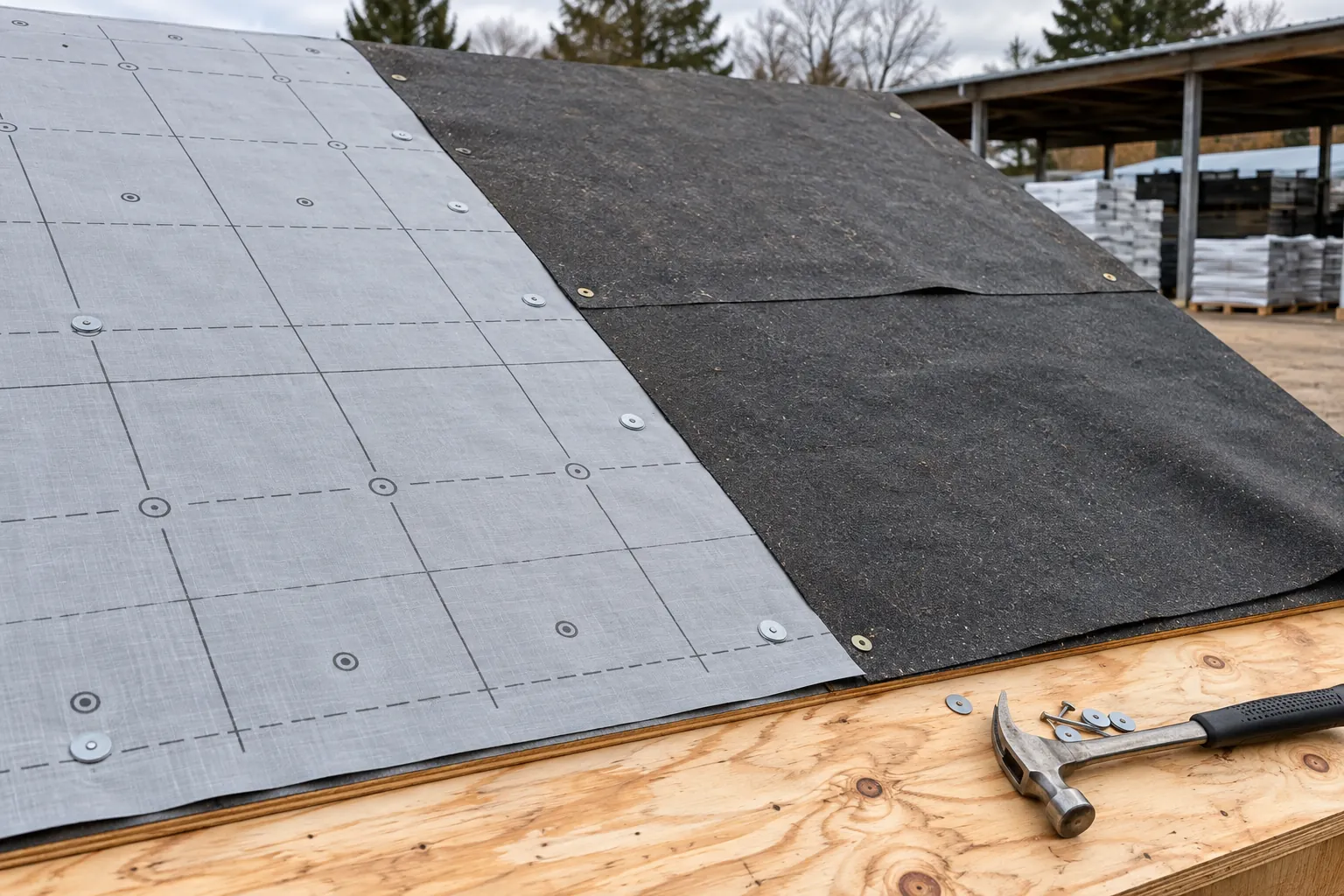
Synthetic vs felt underlayment comparison
Underlayment sits between the roof deck and the primary covering. Once shingles are installed, the layer disappears from view, but it remains part of the assembly. It helps shed incidental water during service and protects the deck during a properly managed installation period.
Synthetic underlayments commonly use polypropylene or polyethylene materials. Traditional felt uses an asphalt-saturated base. Product construction varies within both categories, so the comparison should use the actual data sheets rather than assuming every synthetic or every felt performs alike.
| Factor | Synthetic underlayment | Asphalt felt | What to confirm |
|---|---|---|---|
| Tear strength | Often designed for higher tear resistance and dimensional stability | Can tear more readily when wet, wrinkled, or stressed | Product data and fastening pattern |
| Water resistance | Water-resistant; not automatically a temporary roof | Water-shedding when installed correctly; can absorb moisture | Exposure limit and weather plan |
| Walkability during installation | Many products use textured or high-traction surfaces | Surface and moisture condition affect footing | Manufacturer instructions and crew safety plan |
| Weight and roll coverage | Often lighter with more coverage per roll | Heavier for comparable coverage | Roll size and specified laps |
| Cost delta | [OWNER: verified installed cost difference] | [OWNER: verified installed cost difference] | Same deck, fasteners, laps, and scope |
GAF's FeltBuster instructions describe a UV-stabilized polypropylene product intended to shed water and clearly state that it is water-resistant, not waterproof or a temporary roof. That distinction matters for every underlayment choice. A printed exposure period is not permission to leave the building open to repeated storms.
The roof covering should follow within the manufacturer's allowed conditions and the contractor's weather plan. Open areas, laps, fasteners, transitions, and penetrations must be managed through installation. Underlayment reduces risk; it does not replace scheduling discipline.
What underlayment does—and does not do
Underlayment provides a secondary water-shedding layer beneath shingles. It also separates roofing from the deck and gives the crew a defined surface during installation. Some products contribute specific code or system approvals when installed exactly as evaluated.
It does not correct rotten or delaminated decking. The deck must be suitable, dry, and prepared before underlayment is applied. Covering damaged wood can hide the condition without fixing it.
Standard underlayment is also different from a self-adhered leak barrier. Vulnerable areas such as eaves, valleys, penetrations, and certain transitions may receive ice and water shield based on design, manufacturer details, and applicable requirements. Do not substitute one name for the other in a proposal.
Underlayment does not replace the shingles, flashings, or ventilation strategy. A leak at a chimney or wall cannot be solved by choosing a better field underlayment while leaving the transition detail unclear.
Why cheap quotes cut here first
Underlayment is invisible after the roof is complete, which makes it an easy place to reduce material cost without changing the finished photograph. A proposal that says only “underlayment” gives the bidder room to choose a different product later.
Cost cutting can also appear in laps, fasteners, cap spacing, deck preparation, leak-barrier coverage, and weather protection. Those choices may never appear in a color brochure. The scope should state them before work begins.
A lower-cost felt product is not automatically improper. The problem is a hidden substitution or a comparison between unequal scopes. If felt is intentionally specified and compatible with the roof, explain why. If synthetic is priced, name it.
Review the full quote using the guide on how to read a roofing estimate. Compare line items for deck repairs, leak barrier, field underlayment, ventilation, flashings, accessories, cleanup, and documentation. A single total cannot show where the assembly changed.
Tear strength and wind during installation
Synthetic underlayments are often selected for their tear resistance and lighter rolls. Those qualities can help handling on larger roofs, but fastening and laps still control the installed sheet. A strong membrane can fail locally if fasteners are sparse, proud, or placed outside instructions.
Wind exposure is especially important before shingles cover the sheet. Loose edges can catch wind, and a torn opening can admit water. Crews should secure each course as they proceed and avoid opening more roof than the weather window supports.
Felt can wrinkle after taking on moisture. Wrinkles beneath shingles can affect the finished surface or create installation difficulty. Keeping material dry and following the required lap and fastening pattern matters.
Do not interpret better tear strength as permission to walk carelessly. Every sloped roof surface can be hazardous. Footing, fall protection, weather, slope, debris, and manufacturer instructions remain part of the crew's safety plan.
Water resistance and exposure limits
Marketing language can blur water-resistant, water-shedding, and waterproof. Read the exact product instructions. GAF expressly says its synthetic FeltBuster is not a temporary roof, even though it has a published UV exposure period under standardized testing.
An exposure number may address ultraviolet resistance rather than repeated rain, fastener leakage, wind, or interior protection. Ask how the contractor will close the roof before leaving and what happens if a forecast changes.
Self-adhered leak barriers serve a different purpose at vulnerable details. They bond to a suitable deck and can seal around compatible fasteners. The roof plan should show where field underlayment ends and leak barrier begins.
For occupied homes, interior risk matters. The crew should protect openings and stop before weather threatens. No underlayment label justifies opening the roof ahead of rain.
Walkability, weight, and crew handling
A high-traction synthetic surface can support more controlled crew movement than a smoother product under comparable dry conditions. That is one reason synthetic underlayment is common. The actual product, slope, dust, dew, frost, and temperature can change footing.
Lighter, wider rolls can reduce trips and cover more deck per course. That may improve handling and reduce the number of laps. It does not prove the installed system is better unless the crew follows the printed layout and fastening pattern.
Felt remains familiar and widely understood. Its shorter courses can be practical in some details, while its weight and moisture response require care. Material choice should match the roof and installation plan rather than habit alone.
Homeowners should evaluate documentation, not attempt to observe rooftop walkability. Ask for product information and installation photos from the contractor instead of climbing onto the roof.
What to specify in your estimate
| Estimate item | Minimum useful detail | Why it matters |
|---|---|---|
| Product | Manufacturer, product name, and category | Prevents an undefined substitution |
| Deck condition | Inspection method and unit price or approval process for replacement | Underlayment needs a suitable dry substrate |
| Fastening | Compatible cap fasteners and instruction-based spacing | Controls attachment and local tearing |
| Laps | Side and end laps for the roof slope | Supports water shedding |
| Leak barrier | Separate product and exact locations | Distinguishes vulnerable details from field coverage |
| Exposure | Weather plan and maximum permitted exposure | Avoids treating underlayment as a finished roof |
| Documentation | Product labels and installation photographs | Records what will be hidden by shingles |
For roof replacement in Northern Virginia, require these details before comparing totals. A bid that names the field underlayment but omits leak-barrier locations remains incomplete.
Confirm compatibility with the selected asphalt shingle roofing, deck, slope, and accessories. If a manufacturer system or enhanced coverage is proposed, verify that the named components and installation meet its current requirements.
Read roofing warranties explained before assuming an accessory automatically creates a particular coverage level. Warranty eligibility depends on current written terms, products, installation, registration, and exclusions.
A decision checklist
- Is the exact product named rather than just “felt” or “synthetic”?
- Does the product match the deck, slope, roof covering, and manufacturer instructions?
- Are leak-barrier areas listed separately?
- Does the scope explain damaged decking and concealed conditions?
- Is the weather and overnight dry-in plan clear?
- Will the contractor provide labels and photographs before shingles hide the layer?
Use the checklist during material delivery as well as contract review. Packaging should match the written product, and rolls should be stored as the manufacturer directs. If weather or supply causes a substitution, pause long enough to compare the replacement product's evaluation, exposure instructions, fasteners, and compatibility. A similar color or roll size does not establish equivalent performance.
Ask the completion file to retain the product sheet and representative photographs. Those records can help a future repair contractor understand the concealed assembly. They also provide a clearer answer than trying to identify an underlayment years later from an exposed fragment at a damaged edge.
Synthetic underlayment often wins on handling and tear resistance, but the specification matters more than the category. A well-defined felt assembly can be clearer than an unnamed synthetic product. Make the invisible layer visible in the contract.
Frequently Asked Questions
Is synthetic underlayment waterproof?
Not automatically. Many synthetic underlayments are designed to resist water and shed incidental moisture, but manufacturer instructions may explicitly say they are not waterproof or suitable as a temporary roof. Review the exact product, fastening, laps, exposure limit, and weather plan rather than relying on the word synthetic.
Can roofing felt still be used under asphalt shingles?
Felt can remain a specified option when it is compatible with the deck, slope, covering, manufacturer instructions, and applicable requirements. It must be kept in suitable condition and installed with the correct laps and fasteners. The estimate should name the product instead of using a generic underlayment allowance.
How can I verify underlayment after the shingles are installed?
Ask for the product label, delivery record, and dated installation photographs before the layer is covered. The contract should name the manufacturer and product. Photographs should show representative field coverage, laps, fasteners, leak-barrier transitions, and deck repairs without requiring the homeowner to access the roof.