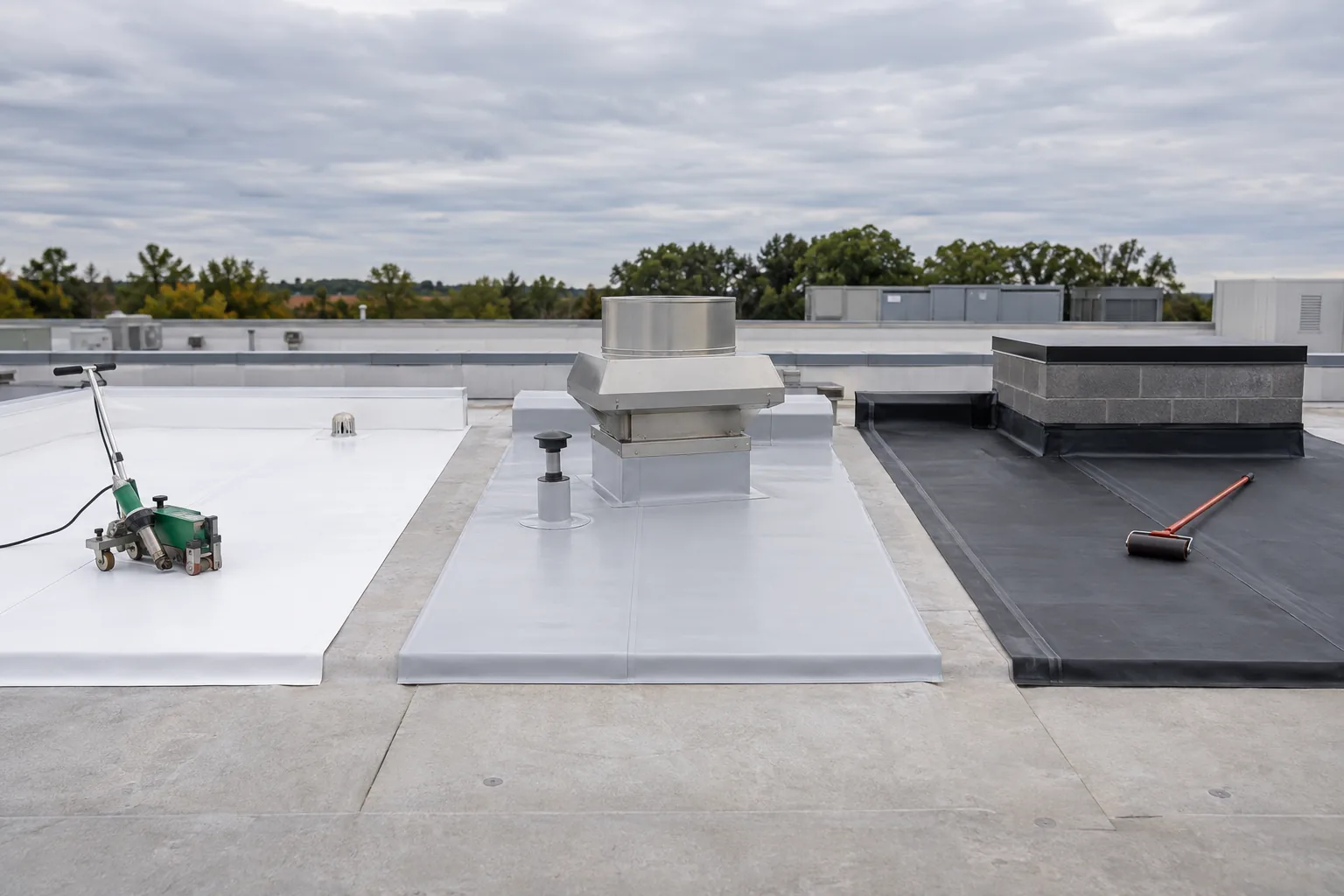
TPO vs EPDM vs PVC comparison
A membrane name is only the start of a low-slope roof specification. Attachment method, membrane thickness, insulation, cover board, drainage, flashings, penetrations, and installer workmanship all affect the finished system. A useful comparison keeps those assembly decisions visible instead of treating the top sheet as the entire roof.
TPO and PVC are thermoplastic membranes. Their field seams can be joined with hot-air welding when the material and equipment are prepared correctly. EPDM is a thermoset rubber membrane, so its seams use compatible tapes or adhesives rather than heat welding. GAF's single-ply overview explains this basic distinction.
| Decision factor | TPO | EPDM | PVC |
|---|---|---|---|
| Installed cost per sq ft | [OWNER: verified TPO cost per sq ft] | [OWNER: verified EPDM cost per sq ft] | [OWNER: verified PVC cost per sq ft] |
| Typical service life | [VERIFY: manufacturer-supported assumption] | [VERIFY: manufacturer-supported assumption] | [VERIFY: manufacturer-supported assumption] |
| Seam method | Hot-air welded | Tape or adhesive | Hot-air welded |
| Reflectivity | Commonly specified in white and reflective colors | Commonly black; reflective versions require product-specific review | Commonly specified in white and reflective colors |
| Chemical and grease exposure | Product-specific limits; protect known exposure areas | Product-specific limits | Often selected for stronger grease and chemical resistance; verify the exact product |
| Repairability | Clean and prepare aged material before welding a compatible patch | Clean, prime, and use a compatible repair system | Clean and prepare aged material before welding a compatible patch |
| Common fit | General commercial roofs seeking a reflective thermoplastic | Simple roofs where a flexible rubber membrane fits the design | Kitchens or facilities with identified grease or chemical exposure |
The cost and lifespan cells remain owner and verification items because neither the brief nor SITE_FACTS supplies a defensible project range. A roof with many curbs, drains, walls, or occupied-space constraints can cost more than a simple open roof using the same membrane. The existing deck and wet insulation can also change the scope.
Ask each bidder to price the same assembly. The proposal should identify membrane type and thickness, insulation value, cover board, attachment, perimeter details, drainage work, demolition, disposal, and warranty path. Otherwise, three prices can represent three different roofs.
PVC for restaurants and commercial kitchens
PVC deserves close attention when rooftop exhaust can expose the membrane to animal fats, cooking grease, or oils. GAF identifies PVC and PVC KEE as options with increased chemical protection and specifically lists grease and animal-fat exposure among the situations where PVC may be selected. This is the clearest case in which PVC can beat a general-purpose TPO choice.
The word “resistant” does not mean immune. Exposure type, concentration, temperature, frequency, cleaning products, and maintenance all matter. GAF also notes that warranties and guarantees may exclude chemical, grease, animal-fat, or jet-fuel exposure. The design team should review the exact membrane data and written coverage rather than assuming the material name settles every risk.
Kitchen roofs need more than a membrane selection. Exhaust discharge, grease containment, access paths, cleaning procedures, and the condition of nearby seams should be addressed together. A compatible sacrificial layer may be appropriate around a known discharge area, depending on the manufacturer's details.
Document every exhaust outlet and its discharge direction during the roof survey. If a future tenant may add kitchen equipment, tell the designer before the roof is specified. A roof chosen for a quiet office occupancy may face a different exposure after a restaurant build-out.
TPO as the commercial default
TPO is often the first system discussed for a broad commercial project because it combines a reflective surface, heat-welded seams, multiple attachment choices, and wide market familiarity. GAF describes TPO as more than half of the single-ply market. That is evidence of broad use, not proof that it is best for every building.
A white TPO membrane can reflect more sunlight than a dark surface. The actual building effect still depends on insulation, roof area, HVAC efficiency, climate, and the product's aged properties. Do not convert a reflectivity label into a promised utility saving. Review the complete assembly and operating conditions.
Heat-welded seams are a practical strength when the membrane is clean and the welding process is controlled. Test welds, equipment settings, substrate conditions, and technician technique matter. A thermoplastic seam is not automatically good because a hot-air welder touched it.
TPO can suit offices, retail buildings, warehouses, schools, and many multifamily or association properties. Its broad use also means compatible accessories and repair experience are generally familiar in the market. The final decision should still address rooftop traffic, drainage, chemical exposure, wind design, and warranty requirements.
Owners comparing commercial roofing options should request one written basis of design. That document keeps membrane comparisons tied to the building rather than to a product headline.
EPDM for budget and simple geometry
EPDM is a flexible rubber membrane with a long history on low-slope roofs. It can be mechanically attached, adhered, or ballasted when the assembly and structure allow it. Its large sheets can reduce the number of field seams on open roof areas, although penetrations and perimeter details still require careful work.
Traditional black EPDM absorbs more solar energy than a white thermoplastic. That fact does not make it wrong for every Mid-Atlantic building. Insulation level, heating and cooling patterns, shaded roof areas, rooftop equipment, and the owner's priorities belong in the evaluation.
EPDM seams and patches depend on compatible tapes, primers, adhesives, and preparation. Dirt, oxidation, moisture, or incompatible materials can undermine a repair. Ask the contractor how the existing sheet will be cleaned and tested before accepting a repair detail.
Simple roof geometry can make EPDM attractive because large sheets can cover open areas efficiently. A complex roof with many small penetrations changes that advantage. Evaluate actual seam length and detail count rather than choosing on membrane price alone.
Which system fits which building type?
Use the building's exposure and operating needs to narrow the list. Then compare complete assemblies through a flat and low-slope roofing review. The table below is a screening tool, not a substitute for design or manufacturer approval.
| Building condition | System to evaluate first | Reason | Question before selection |
|---|---|---|---|
| Restaurant or commercial kitchen | PVC or PVC KEE | Stronger product options for grease and chemical exposure | What exposure does the manufacturer allow, and what does written coverage exclude? |
| General office or retail roof | TPO | Reflective surface and welded seams fit many general commercial uses | What thickness, cover board, and attachment are included? |
| Open roof with simple geometry | EPDM or TPO | Large sheets and fewer details may simplify installation | How many seams and penetrations will the finished layout contain? |
| High rooftop traffic | Assembly-specific comparison | Protection depends on cover board, walkways, and maintenance controls | Where are designated paths and service zones? |
| Existing roof with localized wet insulation | Condition-driven scope | Moisture and deck condition can control whether recover is suitable | What testing defines removal areas? |
Drainage can eliminate an otherwise attractive option if the existing slope or drain layout leaves recurring ponding. Ask how the new assembly will handle current low points and whether tapered insulation or drain work is included. Membrane selection should not hide a drainage problem.
Wind design also applies to the entire assembly. Perimeter and corner zones can require different attachment than the roof field. The applicable design and code requirements must be confirmed for the building and jurisdiction: [VERIFY: current requirement].
If the existing membrane remains mostly sound, a documented assessment may identify a repair or roof coating systems discussion instead of immediate replacement. Saturated insulation, failed seams, or damaged deck can rule out a coating. Start with a free roof inspection and define what further moisture testing the decision requires.
A practical specification checklist
- Name the complete assembly. Record deck, vapor control, insulation, cover board, membrane, thickness, attachment, flashings, and surfacing.
- Map exposures. Identify grease, oils, chemicals, exhaust, foot traffic, shade, and rooftop service areas.
- Test moisture and deck condition. Define which findings trigger removal rather than recover.
- Compare equivalent scopes. Require demolition, disposal, drainage, accessories, and warranty requirements in every bid.
- Plan maintenance. Establish inspection access, cleaning, drain care, and repair documentation for the selected system.
A defensible decision explains why the system fits this roof. It should not depend on one material adjective or the lowest first number. Keep the final product data, approved details, inspection records, and warranty documents with the building's maintenance files.
Frequently Asked Questions
Is TPO better than EPDM for every commercial roof?
No. TPO offers a reflective surface and heat-welded seams, while EPDM can fit simple geometry and uses taped or adhered seams. The better choice depends on the deck, insulation, drainage, roof traffic, exposure, attachment, and project scope. Compare complete assemblies rather than membrane names alone.
Why is PVC often used on restaurant roofs?
PVC and PVC KEE products are often evaluated for restaurant roofs because certain products offer stronger resistance to grease, animal fats, oils, and chemicals. The exact exposure and product data still matter, and written warranty coverage may exclude chemical or grease damage. Exhaust management and maintenance remain necessary.
Can an existing flat roof be covered instead of removed?
Sometimes, but a recover decision requires evidence about moisture, deck condition, existing layers, drainage, attachment, and compatibility. Saturated insulation or damaged deck can require removal in affected areas. The applicable code, manufacturer, and warranty requirements must be verified for the specific building before a recover is selected.
What should a flat-roof quote identify?
A useful quote identifies the membrane and thickness, insulation, cover board, attachment method, demolition, disposal, drainage work, perimeter and penetration details, access, protection, warranty path, and treatment of concealed conditions. Those items make TPO, EPDM, and PVC prices comparable on the same basis.