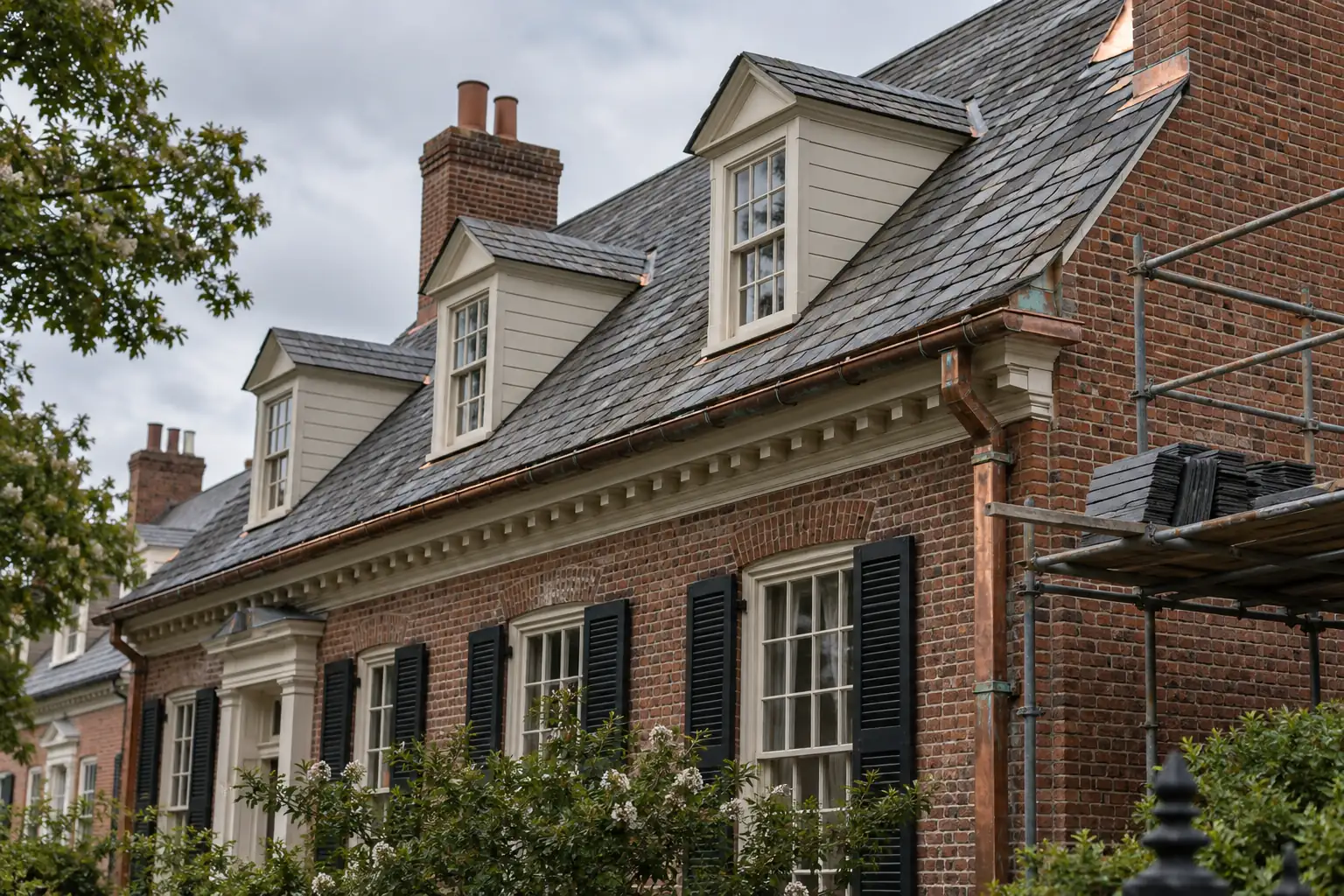
Start by separating slate failure from roof-system failure
Natural slate can outlast several surrounding components. The National Park Service advises repairing historic slate roofs whenever practical and calls flashing a weak point in the system. Sliding units, corroded nails, open valleys, failed chimney flashing, or damaged gutters can create leaks while much of the stone remains serviceable.
The prompt's central point needs that qualification: slate roofs often develop trouble at fasteners and flashing, but some slate also deteriorates, cracks, delaminates, or reaches the end of its useful condition. A sound decision samples multiple slopes and details instead of assuming every leak has one cause.
Map broken, missing, slipping, and previously repaired slates. Record whether damage is isolated, concentrated below a feature, or spread across a slope. Then evaluate flashings, valleys, ridges, penetrations, deck movement, and attic evidence.
How to assess slate condition
A slate specialist can examine hardness, surface flaking, edge condition, thickness, nail holes, and the sound produced by careful professional testing. Color alone does not establish serviceability. Weathering may differ by quarry, exposure, slope, and orientation.
Fasteners deserve their own assessment. Nail sickness can allow otherwise usable slates to slip. Flashing at valleys, chimneys, sidewalls, and penetrations may fail before the field slate. The deck and framing must also support safe repair and future service.
| Finding | Likely path to evaluate | Evidence needed |
|---|---|---|
| Few broken slates; surrounding stone sound | Targeted repair | Mapped defects and compatible replacement slate |
| Widespread slipping with serviceable stone | Fastener-focused restoration or relaying | Fastener, deck, and salvage assessment |
| Failed valleys or chimney flashing | Selective dismantling and flashing replacement | Detail plan and compatible metal |
| Broad delamination or breakage | Replacement comparison | Slope-by-slope condition record |
| Structural or deck damage | Engineered repair plus roofing scope | Qualified structural evaluation where needed |
Matching historic slate
A convincing repair matches more than color. Thickness, size, texture, edge, exposure, and weathering pattern affect how the patch sits and reads from the street. Salvaged slate may help when its condition and source are suitable, while new quarry material may be a better match for other roofs.
The NPS recommends durable, compatible metals and warns against mixing metals in ways that can accelerate corrosion. A repair plan should name the slate and flashing material, not leave matching to the day of work. Mockups can be useful on prominent slopes.
Save serviceable removed slate for future repairs when practical. Store it upright and protected. Document the source and dimensions so later work does not begin from scratch.
Historic review in Old Town Alexandria and Leesburg
Old Town Alexandria properties may be subject to Board of Architectural Review or staff review for visible exterior alterations. [VERIFY: current requirement — confirm with the city before publishing]. Alexandria's adopted roofing guidance differentiates small in-kind repairs from larger work, but staff can change the review level based on the project.
Leesburg's Old and Historic District may require a Certificate of Appropriateness even for in-kind exterior material replacement. [VERIFY: current requirement — confirm with the town before publishing]. The exact property, district boundary, visibility, material, and scope should be confirmed before ordering slate.
Historic approval and building permitting are separate questions. Association review may also apply. Build review time into the schedule and submit clear photographs, material samples, dimensions, and proposed details.
Restoration versus replacement cost
Project cost depends on access, slope, height, salvage rate, slate source, flashing, deck condition, scaffolding, and historic requirements. The site brief supplies no approved price range, so the comparison remains [OWNER: verified slate restoration and replacement ranges].
| Cost driver | Repair or restoration | Replacement |
|---|---|---|
| Slate material | Matched units and salvage handling | Full field quantity plus waste and matching |
| Labor | Selective access and delicate dismantling | Full removal, sorting, deck work, and installation |
| Flashing | Localized or full-detail renewal | New integrated flashing scope |
| Access | May still require full scaffolding | Typically broad access and protection |
| Unknowns | Conditions beneath selected areas | Deck and framing exposed across the roof |
A low repair number can be misleading if it treats symptoms without mapping the roof. A replacement number can also waste serviceable historic material. Use a documented free roof inspection, compare roof repair in Northern Virginia with roof replacement in Northern Virginia, and review roofing materials we install.
How to compare a written roof scope
A useful proposal names the product, every accessory, the deck preparation, flashing work, ventilation work, disposal, cleanup, and treatment of concealed damage. Broad phrases leave important choices until installation day. Ask the contractor to identify exclusions and allowances before comparing totals.
Material labels do not describe workmanship. Fastener placement, laps, transitions, compatible sealants, weather planning, and manufacturer instructions determine how the parts work together. Request representative photographs before concealed layers are covered, then keep them with product labels and warranty documents.
Compare equivalent scopes rather than a single total. One bidder may include deck replacement, specialty flashing, permits, or association paperwork that another leaves open. A lower number is meaningful only after the same work, materials, access, and closeout records appear in each proposal.
Questions to settle before work starts
- What did the inspection establish? Record observed conditions and any areas that could not be seen.
- What exact assembly is proposed? Name products, accessories, attachment, and critical details.
- What can change the scope? State how hidden deck damage or field changes will be documented and approved.
- Who confirms outside approvals? Identify association, historic-review, permit, and manufacturer steps that apply.
- What belongs in the closeout file? Keep photographs, labels, approvals, inspection records, and written warranty documents.
A roof decision should remain understandable after the crew leaves. Clear records help an owner maintain the assembly, explain later repairs, and avoid relying on memory. They also make it easier to see whether a future proposal addresses the same system or quietly changes it.
What the site inspection should document
The inspection should connect visible conditions to the proposed work. Useful photographs show complete slopes and close details at eaves, valleys, ridges, walls, chimneys, penetrations, drainage points, and previous repairs. Attic observations can add evidence about staining, daylight, deck condition, insulation, ventilation paths, and interior moisture, but an attic view cannot prove that every exterior detail is sound.
Record roof geometry, approximate slope, access constraints, landscaping, overhead lines, and areas that require special protection. These conditions affect staging and workmanship even when they do not change the selected material. If an area cannot be inspected safely or remains concealed, identify that limit instead of presenting an assumption as a finding.
Separate observed facts from recommendations. “Three displaced units on the rear slope” is an observation; “replace the rear slope” is a proposed response that still needs a reason. This distinction helps the owner compare contractors who may agree on the condition but recommend different scopes.
Installation-day controls that protect the project
Material delivery should be checked against the contract before installation. Product names, colors, package labels, accessory types, and quantities should match the approved selection. Store materials according to manufacturer instructions and protect them from moisture, deformation, contamination, and jobsite traffic.
The weather plan should limit how much roof is opened at one time and explain how the building will be protected before the crew leaves. Underlayment or a product exposure rating does not make an unfinished roof risk-free. Crews should watch changing forecasts and keep vulnerable interior areas protected while removal is underway.
Quality control is easiest before each layer disappears. Photograph deck repairs, leak barriers, underlayment, flashing, fastener patterns, ventilation work, and completed transitions at representative locations. A final ground-level picture cannot verify concealed details, while an organized progress record can show what was installed.
Closeout and long-term care
The final walkthrough should cover the completed roof, gutters and drainage, siding or landscape protection, magnetic cleanup, remaining materials, and any items scheduled for follow-up. The owner should receive the contract, approved changes, product information, photographs, permit or association records when applicable, and written warranty documents.
Ask what maintenance the manufacturer expects and what activities could damage the assembly. Future satellite, solar, chimney, or mechanical work should be coordinated with qualified roofing professionals so new penetrations and foot traffic do not compromise the finished system. Keep records of later service with the original closeout file.
Schedule condition checks after severe weather and at sensible maintenance intervals based on the roof type and exposure. Owners should make observations from the ground and leave roof access to trained workers. Early documentation of a loose component, blocked drain, damaged flashing, or fallen branch can keep a localized issue from spreading.
Frequently Asked Questions
Can slipping slate be repaired without replacing the whole roof?
Often, yes, when the surrounding slate, deck, and flashings remain serviceable. Slipping can point to fastener failure rather than failed stone. A slate specialist should map the pattern, inspect adjacent units and details, and choose a repair method that avoids damaging otherwise usable slate.
How do you match replacement slate on a historic roof?
Match color, thickness, size, texture, edge, exposure, and weathering pattern. Salvaged or new slate may be appropriate depending on condition and availability. Prominent historic work may also need a sample or mockup and local review before material is ordered.
Does a slate roof in Old Town Alexandria need historic approval?
Exterior roof work may require staff or Board of Architectural Review review depending on the property and scope. [VERIFY: current requirement — confirm with the city before publishing]. Confirm the address, district status, visibility, material, repair area, and building-permit question directly with current city staff.