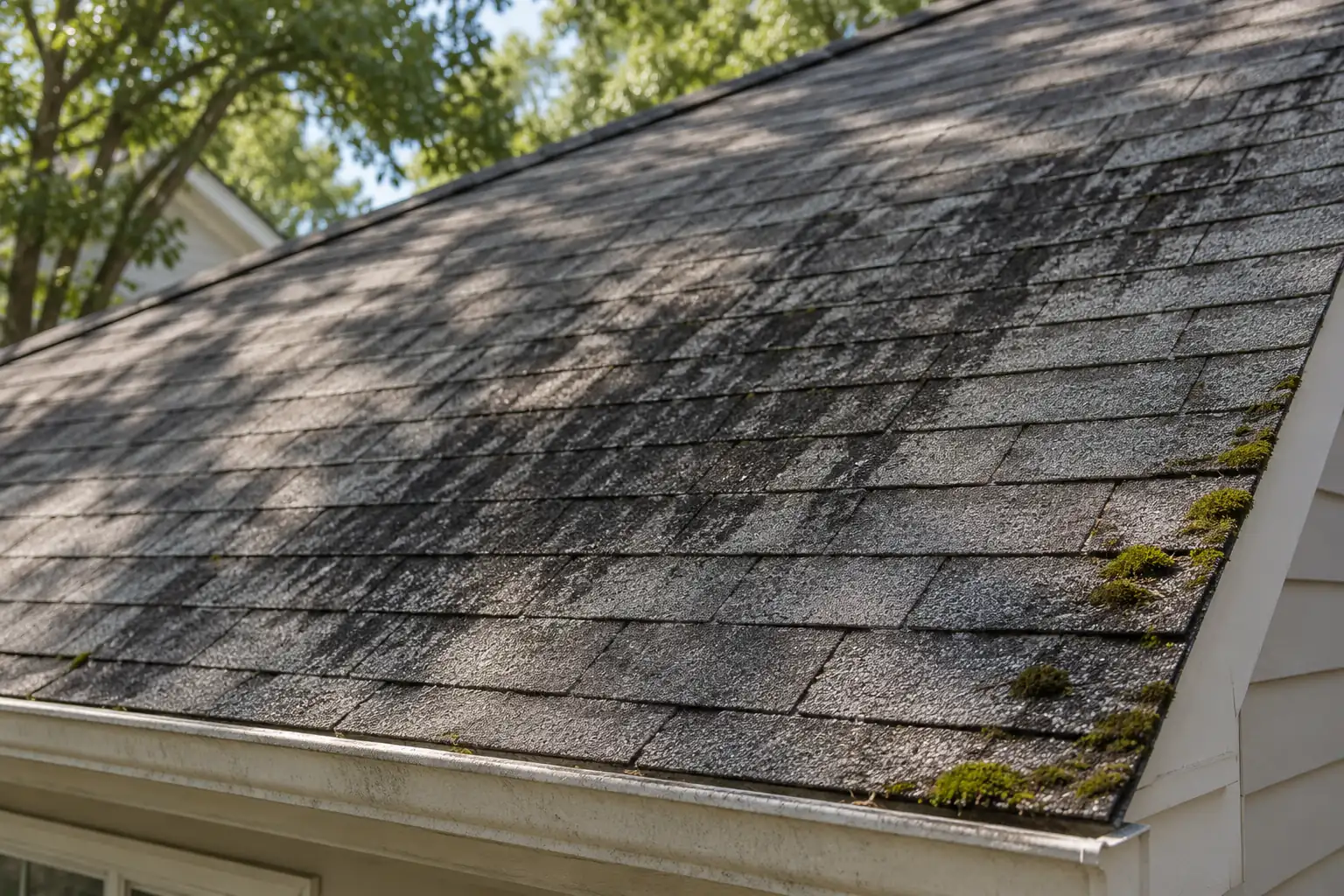
Hero image: AI-generated editorial illustration, not a Rain Guard Roofs customer project.
Why Virginia Roofs Develop Black Streaks
A streaked roof can look badly worn from the street even when the visible change is mainly surface discoloration. Algae associated with black streaks can spread through the air and establish on suitable surfaces. A photograph may suggest that explanation, but it cannot confirm every dark mark or reveal the condition beneath the covering.
Humidity, shade, and slower drying help explain why some roof areas look different from others. A north-facing or heavily shaded slope may remain damp longer than a sunnier slope. Nearby trees can add shade and debris, creating a local condition that matters more than a general description of the neighborhood.
Dark marks can also come from dirt, tree material, metal runoff, or other causes. Record where the marks appear and whether they form a broad streak, a local patch, or a line below a particular roof detail. Ask for identification before accepting a treatment intended for a different problem.
The Asphalt Roofing Manufacturers Association identifies Gloeocapsa magma as a prevalent contributor in its algae discoloration guidance. It also explains that other staining can be mistaken for algae. Use that distinction to frame an inspection, not to diagnose the entire roof from one street photograph.
A roof with discoloration and a roof with leakage need different questions. Note interior water symptoms separately from appearance. Cleaning a stained slope does not repair damaged flashing, an open connection, or a concealed wet layer, and a contractor should explain any proposed repair on its own evidence.
Algae, Moss, and Lichen: Compare the Condition
Algae often appears as dark discoloration or streaking. Moss forms a thicker growth that can retain moisture and interfere with shingle edges. Lichen can appear as attached patches, and attempts to remove it roughly may disturb the shingle surface. The visible category helps guide assessment but does not establish a guaranteed damage level.
Keep the distinction between the growth itself and the condition of the material below it. A small patch can coexist with old or damaged shingles, while a broad discoloration can be mainly cosmetic. Ask the assessor to identify lifted edges, surface wear, drainage issues, and leaks separately from the amount of staining.
| Condition | Typical appearance | Damage concern | Useful next step |
|---|---|---|---|
| Algae | Dark streaks or discoloration | Often cosmetic initially; inspect other defects separately | Confirm the cause and product-approved cleaning options |
| Moss | Raised green growth around edges or shaded areas | Retained moisture and possible lifted shingle edges | Professional assessment of growth and underlying shingles |
| Lichen | Attached crust-like patches | Surface damage can occur during rough removal | Obtain a material-specific treatment plan |
Do not scrape a sample to identify it. A professional can assess the surface with suitable access and equipment. The homeowner’s useful contribution is a safe ground-level photograph, the location of shaded areas, and a note of when the appearance first changed.
The selected shingle manufacturer’s guidance should govern treatment. If the material cannot be identified, ask the provider how that uncertainty changes the proposed method. An unexplained claim that the same cleaning process works safely on every roof is a reason to request a more specific written scope.
What Not to Do to a Streaked or Mossy Roof
Do not use pressure washing to remove growth from asphalt shingles. Aggressive water pressure can damage the protective surface and disturb roof details. ARMA warns against power washing and abrasive brushing; a cleaner should explain how the proposed equipment avoids those actions instead of simply describing the service as a roof wash.
A cleaning-related defect is not the same as a manufacturing defect. Improper methods can affect coverage for the resulting damage, but do not assume the whole warranty is automatically cancelled. Check the issued warranty and manufacturer instructions before authorizing a method that could change the condition of the shingles.
Do not flood the roof with a strong chlorine mixture chosen from a generic online recipe. Excessive or uncontrolled chemical exposure can damage landscaping and affect nearby materials, including metal components. Product compatibility, concentration, application control, and runoff protection belong in the professional plan rather than in an improvised homeowner procedure.
Do not scrape moss, pull at attached patches, or scrub the shingle surface. These actions can loosen granules or damage edges that are already vulnerable. The visible disappearance of the growth is not proof that the roof is in better condition after a harsh treatment.
Do not climb to reach a stain or lean out of a window to apply a product. Wet or treated surfaces create additional access hazards. Obtain a professional plan and keep people, pets, and property clear of the agreed work and runoff areas while the provider handles the roof access.
Safe Removal Means a Manufacturer-Approved Professional Plan
The term soft wash describes an approach, not a complete specification. Ask what product, pressure, application method, and protection measures will be used on the identified shingles. A useful answer refers to the roofing manufacturer’s instructions and explains how delicate edges, flashing, and adjoining surfaces will be protected.
Before treatment, the provider should identify obvious roof defects and explain whether they need attention first. A loose edge or damaged flashing should not be ignored because the visit was booked for appearance. Keep repair recommendations separate from cleaning recommendations so that each has a clear purpose and evidence.
Discuss the protection of plants, painted surfaces, metal, drainage outlets, and adjoining properties. The plan should identify who controls application and runoff and how the area will be checked afterward. Applicable environmental, handling, and access provisions remain [VERIFY: current requirement]; do not assume a product label resolves every site condition.
Ask what improvement is realistic and how the provider will assess it. Some discoloration may lighten gradually or recur, and a promised permanently spotless roof is not a sound basis for choosing a method. Avoid paying for repeated treatment without understanding the shade, moisture, and material conditions that remain.
Rain Guard Roofs' verified services include roofing work; standalone roof cleaning availability remains [OWNER: confirm roof cleaning service availability]. For observed roof defects, discuss roof repair in Northern Virginia. Arrange cleaning with an appropriate provider whose written method is suitable for the installed roof.
Preventing Moss and Algae Without Creating New Damage
Start with conditions that can be observed safely. Overhanging branches can shade a slope and drop material onto it, while accumulated debris can keep local areas damp. Ask a qualified tree professional to assess appropriate trimming; do not cut limbs from a ladder beside the roof or reach across an overhead utility route.
Trimming is a site-specific decision. A tree may provide useful shade or have limits on how it can be altered. Any applicable tree work, association, or local approval provision remains [VERIFY: current requirement]. The roofing observation should identify the concern without prescribing unsafe or unsupported tree work.
Zinc or copper strips are sometimes considered as a growth-control measure. Their suitability depends on the roof material, installation detail, runoff path, and manufacturer guidance. Have a professional evaluate the option rather than attaching metal through shingles yourself or assuming it provides permanent protection across every roof slope.
Algae-resistant shingles offer another material choice when replacement is already justified. Compare the product’s stated algae-resistance terms and limitations instead of assuming resistance means moss-proof or maintenance-free. Keep the product information with the installation record so that future questions concern the actual shingles installed.
Review asphalt shingle roofing and roofing materials we install when discussing a justified replacement. Appearance is one factor alongside condition, compatibility, and the complete assembly. Do not replace a functioning roof solely because a cleaning provider has labelled ordinary discoloration as structural damage.
Deciding Between Observation, Cleaning, Repair, and Replacement
Begin by separating the decisions. Observation documents a visible change; cleaning addresses a suitable surface condition; repair addresses a specific defect; replacement changes a broader assembly. A proposal should connect its recommendation to the findings rather than treating every dark streak as a reason for the most extensive work.
Ask for photographs and a description of the actual roof condition. If replacement is recommended, the provider should identify the evidence beyond discoloration, such as material deterioration or a broader pattern of repair needs. A stain alone does not establish how much useful service remains.
For roof replacement in Northern Virginia, keep the proposed covering, shared details, ventilation review, and any adjacent work in the scope. Address recurring shade and debris separately. Fresh shingles will not change the nearby trees or eliminate the need to observe drainage and surface conditions.
Keep dated photographs before and after any professional treatment. Note the method and products used, roof areas included, defects found, and work completed. These records help distinguish a recurring appearance issue from new damage and give the next provider something more useful than a recollection that the roof was cleaned once.
Compare actual written scopes rather than invented savings or generic price ranges. Cleaning and repair prices remain [OWNER: figure needed] until a suitable provider assesses the property. Ask what is included, which areas cannot be treated, and what happens if the pre-treatment inspection finds a defect requiring another decision.
Keep Prevention Claims Specific
GAF's algae protection information describes material technology intended to resist discoloration. Its zinc strip instructions describe inhibition rather than killing established moss. Neither statement supports a promise that an existing roof will remain clear forever.
Ask for written manufacturer approval before adding a strip to an existing assembly. Guidance can differ by product and purpose, including limitations on adding metal for algae control. Choose a confirmed compatible detail, not a generic prevention claim.
Frequently Asked Questions
Do black roof streaks mean my shingles need replacement?
Black streaks do not automatically mean the shingles need replacement. Algae discoloration is often cosmetic initially, but other staining and separate roof defects can coexist. Obtain identification and a condition assessment before choosing treatment; any replacement recommendation should explain the evidence beyond appearance and distinguish cleaning from actual roofing repairs.
Is pressure washing safe for asphalt shingles?
Pressure washing is not a suitable way to clean asphalt shingles. It can damage the surface and disturb details, and ARMA advises against it. Use a professional method consistent with the instructions for the identified product, with controlled application and protection for adjoining materials and landscaping; do not climb onto the roof to attempt cleaning yourself.
Will algae-resistant shingles prevent moss too?
Algae resistance does not establish that shingles are moss-proof. The product’s stated protection concerns its specified algae performance and terms, while shade, debris, and retained moisture can still create other conditions. Review the manufacturer’s information and keep safe ground-level observations and professional maintenance separate from the choice of a resistant shingle.