Roof coating vs replacement starts with disqualifiers
Saturated insulation, widespread seam failure, and structural deck damage should move an owner out of a coating-only discussion. Treat these findings as reasons to investigate removal and reconstruction before comparing finish materials. A proposal that leaves the underlying failure unexplained is not ready for a capital request.
For saturated insulation, ask the evaluator to map the affected area and define what must come out. For widespread seam failure, request an explanation of whether the membrane remains a dependable base after repair. For structural deck damage, have the appropriate design professional assess the condition and establish the repair scope before selecting the roof covering.
GAF's Liquid-Applied Roofing Manual says wet insulation must be removed before coating and existing leaks must be repaired. It also calls for compatibility, drainage, and adhesion checks. Those are eligibility questions, not optional upgrades to a coating bid.
The business decision follows the condition decision. If repairing the base would consume much of the restoration budget while leaving major uncertainty, request a replacement comparison. If documented repairs produce a suitable base, an evaluation of roof coating systems can move forward.
Use a moisture survey to define the roof scope
Before forwarding a recommendation to the CFO, assemble the roof plan, leak history, past repairs, existing warranty, and available installation records. Ask the evaluator to identify the current roof assembly and explain how concealed moisture will be investigated. Separate confirmed findings from areas that still need investigation.
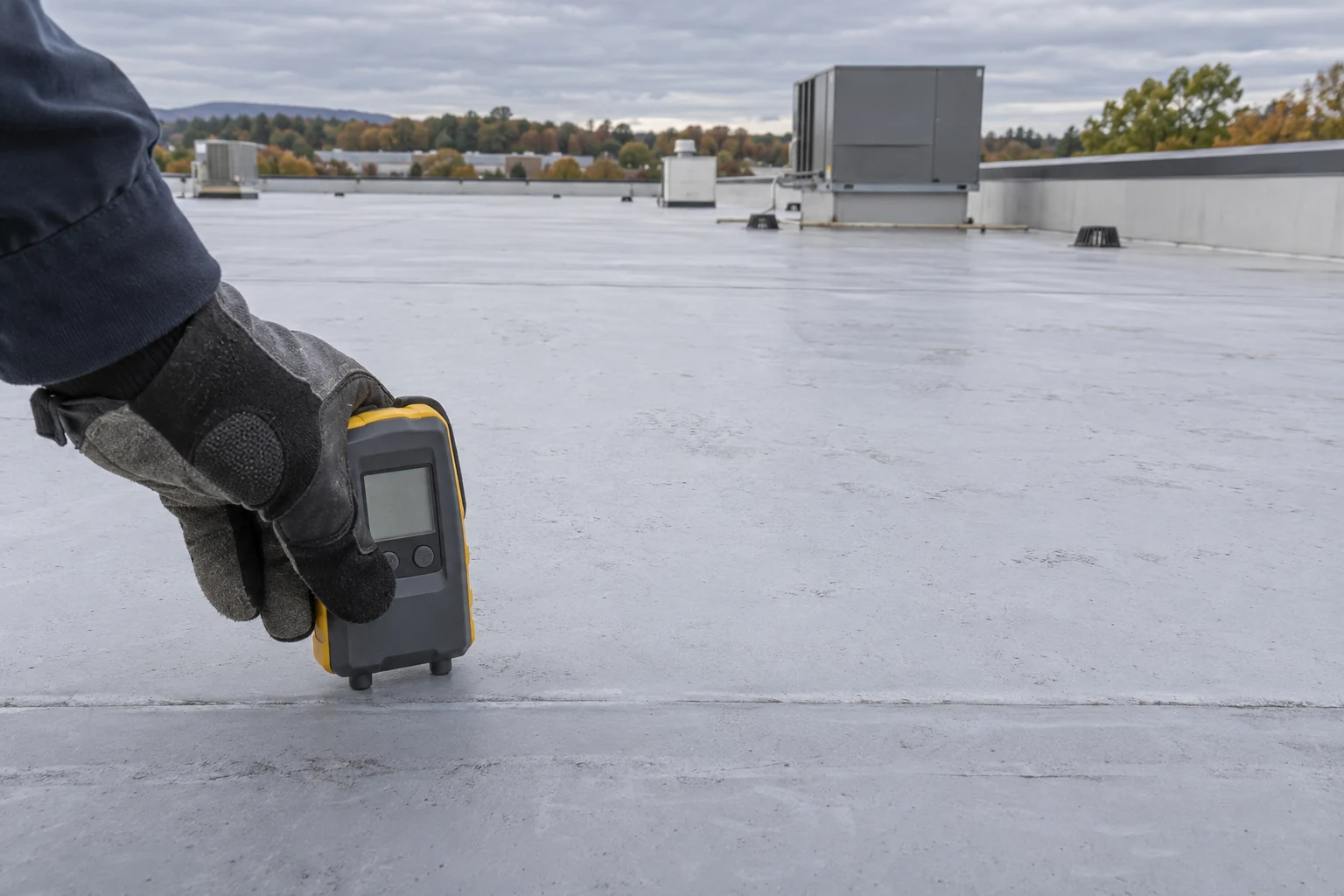
Request a dated moisture-survey report with a marked roof plan, test method, findings, limitations, and proposed follow-up. Ask how suspected wet areas will be checked and how openings made during evaluation will be closed. Do not accept a clean surface photograph as the entire condition record.
GAF requires a moisture survey for eligibility for its Liquid-Applied NDL Diamond Pledge Roof Guarantee. That is a specific manufacturer's guarantee condition; it should not be described as a universal requirement for every coating project. The applicable specification and guarantee must be identified in the proposal.
Ask for repair quantities in sq ft, identified seam work, drainage corrections, and any deck allowance. For an owner managing several buildings, keep these findings by roof section so finance can distinguish a limited repair from an unresolved building-wide concern. The evaluation of flat and low-slope roofing should support that distinction.
Compare installed cost per sq ft on equal terms
A coating quote and a replacement quote are not comparable until each explains the roof area, preparation, removal, repairs, and exclusions. Divide the complete quoted scope by the same measured area. Keep optional work separate, but do not remove necessary repairs simply to improve the displayed price.
| Budget item | Coating proposal | Replacement proposal |
|---|---|---|
| Installed cost per sq ft | [OWNER: verified coating cost per sq ft and included scope] | [OWNER: verified replacement cost per sq ft and included scope] |
| Tear-off required | Identify removal needed for wet or damaged areas | State the proposed tear-off depth and retained layers |
| Removal and disposal | Identify local removal, haul-off, and fees | Identify tear-off extent, haul-off, and fees |
| Hidden-condition allowance | Price additional wet-area repairs | Price additional deck or assembly repairs |
| Tenant disruption | [OWNER: coating disruption days and assumptions] | [OWNER: replacement disruption days and assumptions] |
| Service life | [VERIFY: manufacturer-supported coating service-life assumption] | [VERIFY: manufacturer-supported replacement service-life assumption] |
| Recoat option | Conditional on future condition and manufacturer approval | Evaluate future coating suitability for the selected assembly |
| Future work | Document inspection and possible recoat budget | Document inspection and future repair budget |
Ask each bidder to state the unit price for additional approved repairs and the process for authorizing them. An allowance should identify what it covers and what happens when the actual quantity differs. Keep survey findings beside the allowance so the CFO can see why uncertainty remains.
Request both the cash needed now and the expected future spending categories over the owner's chosen planning period. Include inspections, repairs, possible recoating, and eventual replacement where applicable. Leave unverified costs open instead of filling the model with national averages that may not describe the building.
Tear-off, disposal, and tenant disruption need a plan
Have the coating proposal identify which existing materials remain and which areas require removal. Have the replacement proposal identify the intended depth of tear-off and the handling of exposed areas. Ask for a clear explanation of why the proposed retained layers are suitable and how the selected scope addresses the findings.
Ask for a logistics drawing showing staging, deliveries, debris handling, parking impacts, and tenant access. Confirm who coordinates rooftop equipment and protects sensitive operations below. A shorter written schedule is not useful if it omits preparation or assumes access that the tenants cannot provide.
Keep active construction days separate from calendar duration and actual tenant interruption. Request [OWNER: project-specific coating and replacement schedules, weather assumptions, and affected operating hours]. Ask the contractor to explain cure conditions, weather delays, and any restrictions that could affect deliveries or building operations.
For a facility manager, the useful comparison is operational: which departments need notice, who can approve a schedule change, and how will work be phased? Include that plan in the approval packet alongside the price. An occupied-building commercial roofing scope should make those responsibilities visible.
Separate service life, warranty term, and recoating
A stated warranty term is not a prediction of the exact date a roof will need replacement. For the financial model, request [VERIFY: expected service-life assumptions for the specified coating and replacement assemblies, supported by current manufacturer information and the evaluated roof condition]. Record the source and conditions beside each assumption.
GAF states that some coating systems may qualify for limited guarantees up to 20 years, depending on product selection and contractor certification. That is a manufacturer eligibility statement, not a Rain Guard Roofs warranty offer or a service-life promise. The selected assembly's written terms must govern the project comparison. See GAF's coating system information.
Do not treat future recoating as automatic. Ask what inspection, preparation, compatibility testing, and repairs would be needed before another application could be considered. Request [VERIFY: recoat eligibility, inspection timing, and renewal conditions for the selected manufacturer system] rather than assigning a universal recoat interval.
If the proposal includes roof foam coating, ask it to distinguish the foam work from the protective coating work. List the proposed assembly, thicknesses, substrate repairs, and maintenance documents. Finance should know what the initial project purchases and which later work remains a separate budget item.
Read the actual coating and replacement warranties
Request the proposed manufacturer document and contractor workmanship terms before approval. Compare what causes of leakage are covered, which costs are included, the stated exclusions, and the owner's maintenance duties. Ask who receives notice of a problem and which party performs any covered repair.
Build a short comparison sheet with the named issuer, covered assembly, term, fees, inspection conditions, and transfer provisions. Mark any missing information as unresolved. Do not let matching year counts conceal differences in covered materials, labor, or responsibility for existing roof components.
Rain Guard Roofs should provide [OWNER: exact project-specific manufacturer warranty eligibility and workmanship warranty terms]. Do not assume enhanced manufacturer coverage without confirmation of eligibility for the proposed work. Keep written manufacturer acceptance separate from sales language.
Capital versus operating expense needs finance review
Do not base roof selection on a promise that coating is automatically an operating expense or replacement automatically receives a particular tax treatment. Accounting and tax treatment depend on the project facts and the owner's circumstances. Give the controller or tax adviser the actual scope before assigning the expenditure in the budget.
Use [VERIFY: current accounting and tax treatment for this owner and this scope] in the approval worksheet. Ask finance to identify the assumptions it needs, such as the work performed and the assets affected. Keep the construction recommendation understandable even before that review is complete.
Also distinguish the organization's budget category from the timing of project payments. Request a payment schedule tied to clearly described work, and identify any separately priced investigations. A cash-flow comparison should use the proposed contract terms rather than an assumed payment pattern.
Evaluate reflectivity without promising utility savings
The Department of Energy explains that reflective roofs reduce absorbed solar energy and that climate and building characteristics affect the energy result. A cool roof can also increase heating demand. That makes a blanket utility-saving promise unsuitable for a Virginia facility. See DOE's cool roof purchasing guidance.
Request the proposed product's documented solar reflectance and thermal emittance, including aged values where available. Keep those properties distinct from added insulation. If energy savings are important to approval, ask for a building-specific analysis using the existing assembly, HVAC operation, utility information, and local climate.
Show any modeled result as an estimate with assumptions, not a guaranteed reduction in bills. Compare the actual proposed coating and replacement surfaces. Do not credit reflectivity to only one option without checking the specifications for both.
A decision checklist to send to the CFO
- Condition: Are saturated insulation, seam failure, and deck concerns resolved in the written scope?
- Evidence: Does the packet include the moisture report, roof plan, repair quantities, and remaining unknowns?
- Cost: Do the proposals use the same roof area and show preparation, tear-off, disposal, and allowances?
- Operations: Are tenant disruption days, access needs, weather assumptions, and coordination responsibilities stated?
- Future spending: Are maintenance, possible recoating, service-life assumptions, and warranty terms documented?
- Approval: Has finance reviewed accounting treatment, payment timing, and the acceptable contingency?
Recommend coating when the documented condition and complete scope support retaining the assembly. Recommend replacement when the findings support removing failed components and rebuilding the roof. If investigation is incomplete, request the remaining evidence before presenting either option as a final recommendation.
Frequently Asked Questions
Can a roof coating fix a leaking commercial roof?
A coating should follow diagnosis and repair of existing leaks. Ask the evaluator to identify the failure, confirm the condition below the surface, and document the proposed repair before coating begins. GAF guidance calls for existing leaks to be repaired first, so a proposal should not treat the coating application itself as the entire leak-repair scope.
Is roof coating cheaper per sq ft than replacement?
The answer requires comparable project quotes that include necessary preparation and repairs. Ask for the same measured roof area, removal and disposal costs, wet-area allowances, and any excluded work. Use [OWNER: verified project-specific coating and replacement cost per sq ft] in the budget comparison instead of assuming that a lower surface-application price represents a lower complete project cost.
How many days will tenants be disrupted?
The disruption period must be established for the specific building and scope. Ask for [OWNER: coating and replacement tenant disruption days] with access, staging, operating-hour, and weather assumptions. Distinguish calendar duration from the hours tenants actually lose access or operations. Have the facility manager confirm those assumptions before the schedule becomes part of the approval request.
Can a commercial roof be recoated instead of replaced again?
Recoating may be considered only after the existing system is evaluated for another application. Request the manufacturer-specific inspection, repair, compatibility, and renewal conditions before budgeting it as the next step. A future recoat should remain a conditional planning assumption; documented roof condition and the applicable system instructions must support that decision at the time.