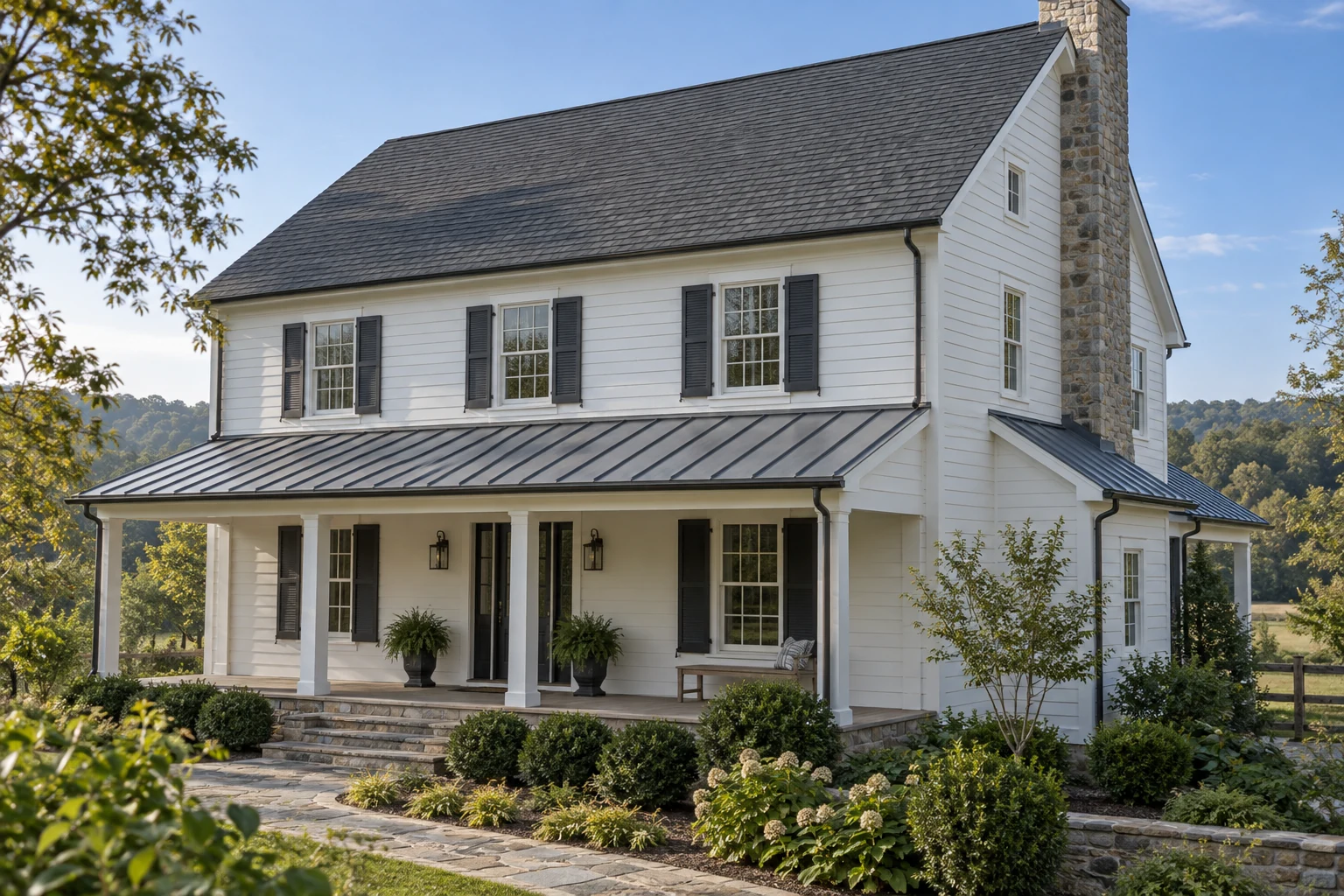
Metal roof vs asphalt shingles in Virginia: compare complete systems
Start by defining the metal option. This comparison focuses on standing seam, rather than treating every metal roof as the same product. Panel profiles, attachment methods, finishes, and roof details belong in the proposal because a material label alone does not describe the system you are buying.
For asphalt, name the actual shingle as well. A proposal for an unspecified shingle is difficult to compare with a detailed metal specification. Ask each proposal to describe preparation, decking assessment, underlayment, flashing, ventilation review, and cleanup.
McElroy Metal distinguishes exposed-fastener panels from other metal systems and notes that some residential profiles are designed for solid decking. That is a reason to identify the actual assembly before comparing prices or expected performance. Do not apply a claim about one metal product to every metal roof.
Review the available standing seam metal roofing system alongside a named shingle proposal. Your roof shape, preferred appearance, and ownership plan should guide the comparison. A long planning horizon does not remove the need to check what is included on installation day.
Head-to-head roof material comparison
| Decision | Standing seam metal | Asphalt shingles |
|---|---|---|
| Appearance | Compare the selected panel, seam pattern, finish, and trim samples. | Compare the selected shingle pattern, color, and ridge details. |
| Initial price | Use a property-specific installed quote. | Use a quote with the same underlying project scope. |
| Long-term cost | Model possible repairs and component work; do not assume zero maintenance. | Model repairs and possible replacement events with stated assumptions. |
| Service life | The 50-year worksheet is a scenario, not a promised roof life. | Replacement counts in the worksheet are assumptions, not a guaranteed schedule. |
| Rain noise | Assess decking, underlayment, insulation, attic, and ceiling together. | Use the same interior assembly when comparing comfort expectations. |
| Solar mounting | Compatible standing seams may accept engineered non-penetrating clamps. | Obtain the proposed attachment and flashing details from the solar designer. |
| Appearance approval | Verify the property's current material and color review process. | Verify the same process even when the new material resembles the old roof. |
| Resale | Do not assume a price premium or recovery of the upgrade cost. | Do not assign a return without relevant property-specific evidence. |
The table deliberately leaves prices and replacement dates open. Filling those cells with unsupported numbers would create a precise-looking answer without a reliable foundation. Written quotes and clearly labeled assumptions make the comparison reviewable.
The 50-year math is an illustration, not a lifespan forecast
Consider an illustrative scenario in which the metal system remains in service throughout a 50-year study period while the asphalt option involves two complete installations. The asphalt count includes the initial installation and one later replacement. This is a modeling choice, not a claim that either material will follow that schedule.
Then test an alternative with three asphalt installations: the initial roof and two later replacements. Also test a case where the metal system requires substantial work or replacement within the study period. A fair worksheet allows the preferred option to perform less well than expected.
Ask for product-specific planning evidence before deciding which scenario best fits the roof. [OWNER: supply manufacturer-supported service-life planning assumptions for the proposed systems, with exposure and maintenance conditions.] Keep those assumptions visible beside the results instead of hiding them inside a calculator.
A 50-year horizon may help a long-term owner compare possibilities, but it can be less relevant to someone expecting to sell sooner. Run a separate comparison through your intended ownership period. Future costs after a sale are not automatically savings that the current owner receives.
Build the worksheet from real installed quotes
Let A represent measured roof area in sq ft, rather than the home's interior floor area. Let m and s represent comparable installed prices per sq ft for the selected metal and shingle systems. [OWNER: real per-sq-ft ranges for standing seam metal and asphalt shingles, with scope, measurement method, date, and exclusions.]
For a simple constant-dollar illustration, the initial metal cost is A × m and the initial asphalt cost is A × s. If each future asphalt installation is deliberately assumed to cost the same in constant dollars, two installations total 2 × A × s before other costs. Three installations total 3 × A × s on that same assumption.
This shortcut needs an explanation: a later replacement may have a different scope from today's work. Tear-off, access, decking condition, and any solar removal can differ. Use separate event estimates when available instead of automatically multiplying the first quote.
| Worksheet item | Definition or formula | Input needed |
|---|---|---|
| A | Measured roof area in sq ft | [OWNER: project roof area] |
| m and s | Comparable installed cost per sq ft | [OWNER: real per-sq-ft ranges] |
| M | Total modeled metal repair and maintenance costs | [OWNER: documented planning allowance] |
| S | Total modeled asphalt repair and maintenance costs | [OWNER: documented planning allowance] |
| Two-installation asphalt scenario | 2 × A × s + S | Assumes equal constant-dollar installation costs |
| One-installation metal scenario | A × m + M | Assumes no complete metal replacement during the study period |
| Illustrative difference | (2 × A × s + S) − (A × m + M) | A positive result favors metal only under these assumptions |
If the simple difference is positive, the modeled metal total is lower. If it is negative, the modeled asphalt total is lower. Neither result establishes what will happen to a particular roof, and neither includes costs that you have left outside the worksheet.
List exclusions clearly, such as financing, future price changes, taxes, unusual repairs, and any remaining roof value at the study period's end. A simple undiscounted worksheet does not measure the different timing of future payments. Keep that limitation visible rather than presenting the result as an investment return.
Check for double counting. If a replacement quote already includes disposal or flashing work, do not add the same item again under maintenance. Conversely, do not omit an expected item simply because the material supplier's brochure does not discuss its cost.
Compare ownership plans before choosing a horizon
For a long hold, consider the inconvenience and uncertainty of future work along with the model totals. Ask what records and maintenance expectations come with each system. A lower modeled cost is less persuasive if its assumptions do not match the way the property will be managed.
For a shorter hold, focus first on the initial project, your budget, and the roof condition you expect to document at sale. Do not credit the metal option with an assumed resale premium. Do not assume that choosing asphalt will reduce the sale price, either.
Appearance is a valid preference even without a calculated payback. A homeowner may prefer the selected metal panel or the texture of asphalt shingle roofing. Keep that preference separate from the cost worksheet so the calculation does not disguise a personal design choice as a financial fact.
Rain noise depends on the full roof assembly
The sound of rain on an open metal shelter does not establish how a finished house will sound. McElroy Metal explains that decking, underlayment, insulation, and interior building layers reduce rain noise. Its residential guidance compares complete residential assemblies, rather than bare panels alone.
Ask what sits between the roof covering and the room where noise matters most. A finished upper-floor bedroom, an attic, and an open porch are different situations. Request an explanation tied to that specific construction rather than a blanket promise that every metal roof is silent.
The manufacturer's technical guidance also discusses expansion, contraction, and panel movement as possible noise sources. Rain is therefore only one part of an acoustic discussion. If sound is a priority, make it a design question before the system is selected.
Check HOA review before ordering materials
A material change can also be an appearance decision involving the property's governing documents. [VERIFY: current requirement] Confirm the applicable HOA or architectural review procedure, including allowed materials, colors, submission documents, and any required written approval. Verify those details for the actual property.
A nearby metal roof does not prove that your proposal has approval. The neighboring home may be subject to different documents or an earlier decision. Submit the proposed product and color rather than relying on a verbal description such as dark metal or standard shingles.
Keep approval records with the contract and material selection. If local permitting or historic review applies, confirm that separately. [VERIFY: current requirement] This article does not establish any jurisdiction's current permit, code, or approval rules.
Plan solar around a compatible attachment system
Some standing seam systems allow solar attachments that grip the seam without piercing the roof panel. S-5! explains that its clamp selection and holding strength depend on the seam profile, material, and gauge. Non-penetrating is therefore a feature of a compatible, specified attachment system, not every metal roof.
Have the solar designer identify the panel profile, compatible clamp, tested capacity, layout, and applicable installation instructions. Ask the roof and solar teams to coordinate warranty conditions and attachment design. [VERIFY: current requirement] Confirm any applicable structural, electrical, and permitting requirements for the project.
For either roof covering, ask how future roof work would affect the solar equipment. If a scenario includes removal and reinstallation, add a documented allowance rather than an invented number. Do not assume Rain Guard Roofs provides solar installation; coordinate that scope with the selected solar provider.
Choose with a complete scope and honest assumptions
Request the named products, assembly details, warranty documents, complete price, and allowance terms for each option. Record the unresolved questions beside the 50-year worksheet. An assumption that materially changes the result deserves a clear explanation before it influences your decision.
Rain Guard Roofs is based in Sterling and serves a 30-mile radius from its office. A discussion about roof replacement in Northern Virginia can start with your roof conditions and ownership plans. The useful outcome is a comparable scope and a reasoned material choice, with costs and service-life assumptions clearly identified.
Frequently Asked Questions
Will one metal roof really outlast two asphalt roofs?
That outcome is a scenario to test, not a promise for your home. The 50-year worksheet assumes one metal installation and two or more asphalt installations to show how replacement counts affect cost. Product selection, installation, exposure, maintenance, and unexpected damage can change both paths, so use supported assumptions and compare alternative cases.
Is a metal roof louder than shingles during rain?
Noise depends on the complete assembly, so the roof covering alone cannot answer the question. Manufacturer guidance identifies decking, underlayment, insulation, and interior layers as important to reducing rain sound. Ask about the specific room and roof construction, including any concerns about panel movement, rather than comparing a finished house with an open metal shelter.
Can solar panels attach without holes in a standing seam roof?
They can when a compatible, properly specified standing seam clamp system is used. The seam profile, metal, gauge, attachment capacity, and installation instructions must match the design. This does not apply to every metal roof. Have the solar designer and roofing provider coordinate the attachment details and applicable warranty conditions before installation.
Does metal roofing increase a Virginia home's resale value?
No resale increase is established for your property in this comparison. Buyers may have different preferences, and a material upgrade does not automatically return its cost at sale. Keep any expected resale benefit outside the worksheet unless you have relevant supporting evidence, and focus first on the installed scope, your ownership period, and your budget.