What Northern Virginia HOAs regulate
An association may regulate the parts of a roof that affect exterior appearance: shingle or panel material, manufacturer color, profile, visible flashing, gutters, vents, and sometimes whether attached homes must be completed together. The governing declaration, design guidelines, cluster standards, and current application control the property. [VERIFY: current association requirement].
“Like for like” can have a narrow meaning. A gray architectural shingle is not automatically equivalent to a different gray, and a synthetic cedar profile may not qualify as natural cedar. Product names also change. Ask the association to confirm the current approved product and color rather than relying on a neighbor’s older project.
Roofing approval and a government permit are separate questions. An HOA decision does not replace county or town review, and a permit does not override private covenants. [VERIFY: current requirement]. Start by identifying every reviewing body tied to the address.
| Review item | What the association may compare | Best evidence |
|---|---|---|
| Color | Approved palette and neighboring roofs | Manufacturer color name plus physical sample |
| Material | Asphalt, cedar, composite, slate, or metal | Current product data sheet |
| Profile | Three-tab, dimensional, shake-look, slate-look, or panel geometry | Large sample and installed examples |
| Attached housing | Uniformity across one connected structure | Roof plan and coordinated-owner scope |
| Accessories | Visible vents, flashings, gutters, and edge metals | Color and detail schedule |
| Work timing | Approval expiration and completion notice | Written decision and contractor schedule |
Named association roof approval processes
Reston Association Design Review Board
Reston Association publishes a Design Review Board application, design guidelines, cluster standards, advisor contacts, and a sample roof application. The property’s cluster standard and the type of change can affect the route. [VERIFY: current Reston Association process]. Contact the assigned Covenants Advisor before finalizing material.
Ashburn Village
Ashburn Village publishes an online Exterior Modification Application and Architectural and Environmental Guidelines. Its current site says exterior changes to single-family homes and townhomes require approval before installation and identifies a monthly review meeting. [VERIFY: current Ashburn Village deadline, meeting, completion, and roof requirements].
Brambleton
Brambleton’s published process sends exterior appearance changes to its Covenants Committee. The checklist calls for a complete application, property photographs, material pictures with manufacturer and color, and other project documents. [VERIFY: current Brambleton submission deadline, meeting cycle, and roofing criteria].
Cascades
Cascades publishes a design-review form that expressly lists roof replacement and asks for pictures or samples, a description, and proposed dates. The form also publishes a committee cycle and advance deadline. [VERIFY: current Cascades form, deadline, meeting, and product rules].
Countryside
Countryside publishes architectural applications and a specific townhouse roof replacement checklist. That checklist requests the existing and proposed style and color plus product information and a sample, and it identifies restrictions for named townhouse sections. [VERIFY: current Countryside neighborhood-specific requirements and review route].
Broadlands
Broadlands publishes roofing guidelines that distinguish some exact-match single-family replacements from attached housing and material or color changes. It also publishes a modification application with a roof-replacement category. [VERIFY: current Broadlands exemption, attached-home, color, material, and submission requirements].
The roof approval packet
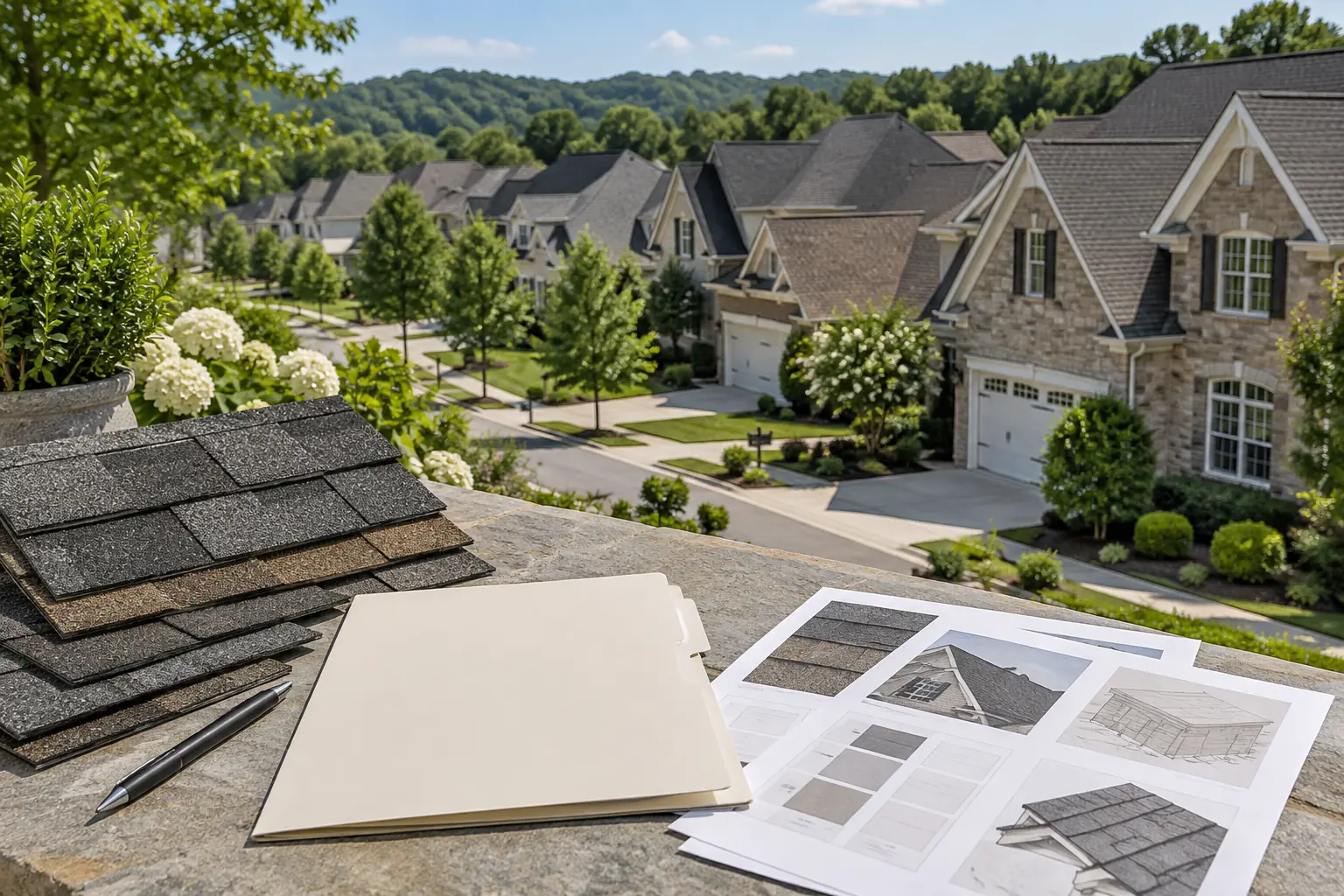
A strong packet contains the current application form, exact product specification, full manufacturer color name, a physical or high-quality color sample, photographs of every visible roof plane, and a concise scope. Add the contractor’s current Virginia license and insurance certificates when the association requests them. [VERIFY: association packet requirement].
Include the address, property type, proposed start and completion dates, and whether the change is an exact match or a new material, profile, or color. Attached homes need a simple diagram showing the shared structure and the limits of work. Historic or unusual materials may need larger samples or a mockup.
The brief asks Rain Guard Roofs to state that the company prepares the packet. SITE_FACTS does not verify that service promise, so publish it as an owner item: [OWNER: confirm Rain Guard Roofs prepares and submits HOA approval packets, including exact documents and responsibility]. Until confirmed, Rain Guard Roofs can supply product information and contractor documents requested for the owner’s application.
For HOA and condo association roofing, keep one PDF copy of the complete submission and every later revision. If a product becomes unavailable, obtain written approval for the substitute before delivery.
Timeline planning around meeting cycles
Some communities publish monthly committee meetings and submission cutoffs; others allow staff review for conforming work. A missed cutoff or incomplete packet can push the decision to a later cycle. [VERIFY: current association timing]. Material lead time and contractor scheduling should begin only after the approval path is understood.
Work backward from the desired installation window. Allow time to gather samples, answer staff questions, revise a color, coordinate attached owners, and receive the written decision. Approval commonly taking “several weeks” comes from the brief as planning guidance, not a guarantee for every association.
Peak storm periods can add demand at the same time association queues grow. Ask for the approval expiration date and whether the owner must submit a completion notice. Do not let a tentative crew date pressure the owner into starting before written approval.
Common denial reasons and practical fixes
- Unapproved color: choose from the current palette or submit a clearer comparison and rationale.
- Profile mismatch: provide a larger sample and select a profile consistent with the governing standard.
- Incomplete application: add missing photographs, signatures, product data, dates, or plot information.
- Attached-roof inconsistency: coordinate the connected units and show how transitions will be handled.
- Material substitution: stop and obtain written approval for the new product.
- Visible accessory conflict: revise vent, flashing, gutter, or edge colors to match the approved scheme.
A denial should identify the decision and appeal or resubmission route in the association documents. [VERIFY: current process]. Respond to the stated reason with a revised packet rather than ordering a near match and hoping it passes inspection.
Emergency roof repairs
Associations may treat temporary work needed to protect a building differently from permanent replacement, but no universal exemption should be assumed. [VERIFY: current emergency-repair requirement]. Ask the association in writing what immediate stabilization is allowed, what notice is required, and when the permanent material must be reviewed.
Photograph the condition from safe locations, protect the interior, and use a documented temporary scope. Emergency work should preserve options for the approved repair. For urgent conditions, use roof repair in Northern Virginia and confirm the association record as soon as practical.
Virginia Property Owners’ Association Act context
Virginia’s Property Owners’ Association Act defines associations and addresses matters including rules, records, meetings, enforcement, and owner rights. The association’s recorded declaration and adopted rules remain central to a roof application. This discussion is factual background, not legal advice.
Owners with a dispute should read the current governing documents and Virginia law and seek qualified legal advice for their situation. Do not treat a contractor’s experience as a legal interpretation. A roofing proposal should describe construction work, documents, and scheduling without promising an association outcome.
Plan roof replacement in Northern Virginia early, use roofing in Ashburn, VA resources for Ashburn-area properties, and consult the site’s Reston service-area page with descriptive text because its requested anchor is not present in the current anchor bank.
Keep an approval record through construction
The written approval should travel with the project from product selection through closeout. Before delivery, compare the approval letter with the manufacturer, line, profile, and color printed on the bundle labels. Photograph those labels and the unopened sample next to the approved submission. This simple check catches substitutions caused by availability, distributor picking errors, or a color name that resembles another product.
During construction, retain photographs of the visible roof planes, flashing colors, vents, gutters, and shared transitions. If field conditions require a visible change, pause that portion and ask the association whether an amendment is needed. [VERIFY: current association change process]. A verbal comment from a neighbor, committee volunteer, salesperson, or crew member is not the written decision tied to the property.
At closeout, save the decision letter, submitted application, final product data, photographs, contractor invoice, and any completion notice together. Future owners may need the record during resale, and the association may ask how the finished roof matches what it approved. If work spans attached units, each affected owner should retain the same final scope and color record.
This file also helps separate private design review from contractor warranties and government inspections. Each document answers a different question. Approval shows the association accepted the exterior proposal; an inspection addresses the work reviewed by the jurisdiction; product and workmanship records explain coverage and maintenance. None substitutes for the others.
Questions to settle before signing
Before signing a construction agreement, identify the approved product, the person responsible for submitting the application, and the condition that allows scheduling to proceed. The contract should explain what happens if the association rejects a proposed color, requests a different sample, or takes longer than anticipated. Do not assume silence means approval. [VERIFY: current association decision rule].
Ask whether delivery deposits, material restocking, or schedule changes apply while approval is pending. Confirm that the proposal distinguishes association-requested appearance changes from roof work needed for performance. Finally, make sure the approval is tied to the same scope, address, and product described in the construction documents.
Frequently Asked Questions
How long does HOA roof approval take in Northern Virginia?
It varies by association, completeness, staff authority, and committee calendar. Several weeks is a sensible planning allowance from the brief, but it is not a universal promise. [VERIFY: current association timing]. Check the current submission cutoff, meeting date, decision notice, resubmission process, and approval expiration before scheduling work.
What roof sample should I send to my HOA?
Send the exact manufacturer, product line, profile, and color name, plus a physical sample or clear product image when accepted. Include photographs of the existing house and nearby roof context. Ask whether the association requires a full shingle board, installed example, accessory colors, or an attached-home coordination plan.
Can emergency roof work begin before HOA approval?
Temporary protective work may follow a different process, but an exemption is not universal. [VERIFY: current emergency-repair requirement]. Notify the association in writing, describe the immediate condition and temporary scope, keep photographs, and ask when the permanent repair or replacement application must be submitted.
Does Rain Guard Roofs prepare HOA applications?
[OWNER: confirm Rain Guard Roofs prepares and submits HOA approval packets, including exact documents and responsibility]. Rain Guard Roofs can provide relevant product information and contractor documents requested for an owner’s packet, but the owner should confirm who submits the application and who receives the written decision.