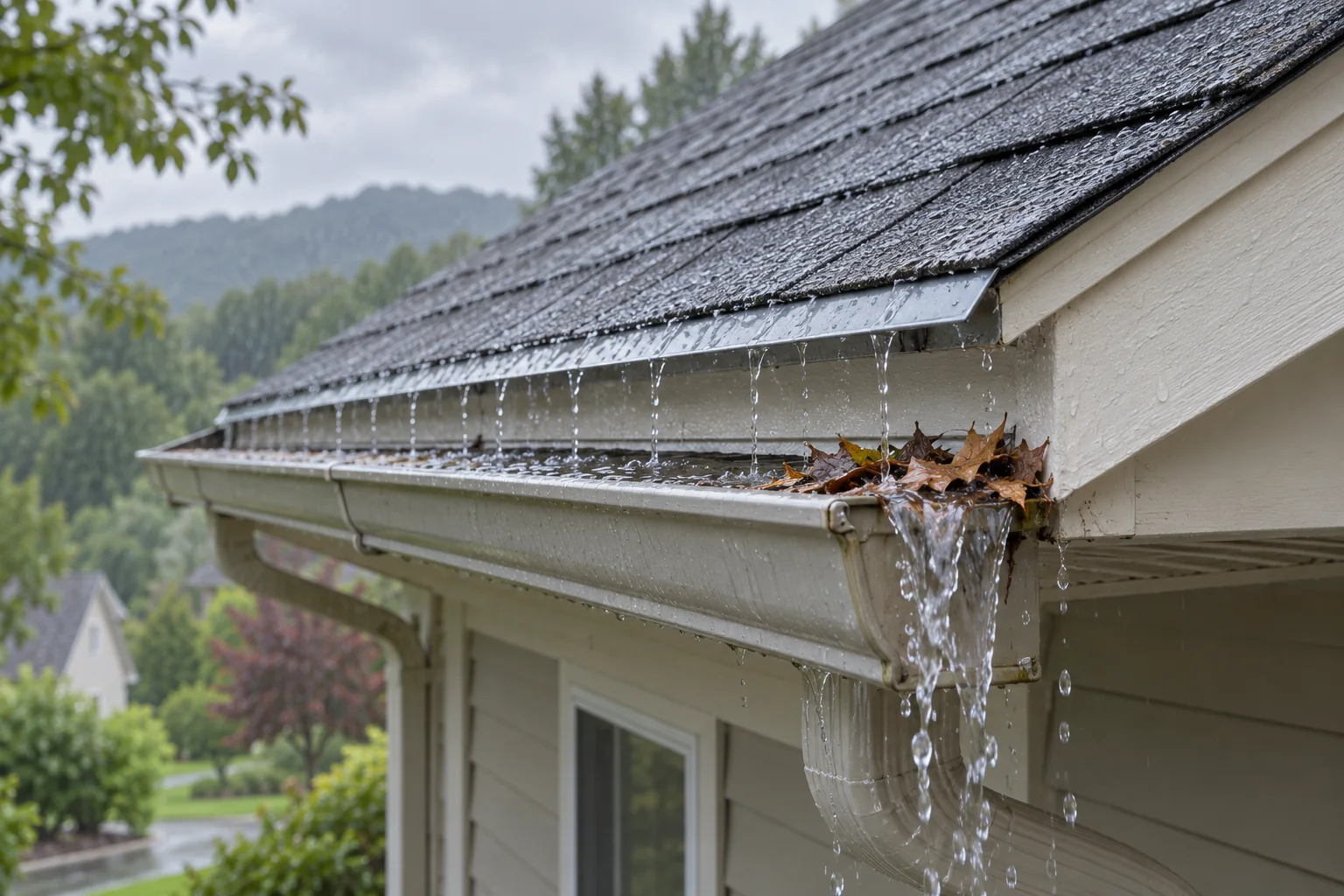
Hero image: AI-generated editorial illustration, not a Rain Guard Roofs customer project.
The Gutter and Drip Edge Connection
The roof edge is a transition between the covering, underlayment, edge metal, fascia, and gutter. Its purpose is to direct runoff outward along an intended path. A gutter can be clean yet still perform poorly if the edge arrangement allows water to run behind it or onto vulnerable trim.
Drip edge details depend on the roof assembly and the manufacturer’s installation instructions. Ask the contractor to explain the existing arrangement and any proposed change with a drawing or photographs. Applicable edge flashing and drainage provisions remain [VERIFY: current requirement]; a general online sketch does not settle the detail for every house.
Observe what happens from a sheltered ground position during ordinary rain, without approaching standing water or electrical hazards. Water spilling over the front, leaking at a joint, or running behind the gutter suggests different questions. Record the location rather than describing every symptom as a gutter leak.
Do not assume that a line of sealant is the permanent answer. A shifted gutter, damaged edge metal, deteriorated support, or an unsuitable connection may need a different correction. The provider should identify the cause and explain how the proposed work changes the water route.
The Building America gutter and downspout guide treats roof runoff as a connected system. Apply that principle to the entire route from roof edge to discharge. Improving a visible gutter section will not help much if water remains blocked farther along the path.
Overflow Can Damage Fascia and Soffits
Repeated wetting can affect fascia boards, soffit areas, and the materials around the eaves. Peeling paint, dark staining, or visible distortion may be warning signs, but a ground view cannot establish the extent of concealed deterioration. Ask for a professional assessment before replacing only the visible finish.
Different overflow patterns point to different causes. A local blockage may affect one outlet, while a sagging section may retain water along a longer run. Water behind the gutter can indicate an edge or positioning issue. A useful repair plan describes which pattern was found rather than treating all wet trim the same way.
Gutter supports rely on the condition of the material they attach to. If that support is damaged, rehanging the gutter without addressing it may leave the same weakness in place. Ask the provider to document the supporting surface and explain any concealed damage allowance before committing to an installation scope.
Damage at the eave can also involve roof components above the fascia. The assessment should consider the covering, edge flashing, underlayment, and nearby wall or porch connections where relevant. A freshly painted fascia does not demonstrate that the source of wetting has been corrected.
For a roof defect found during the review, discuss roof repair in Northern Virginia with the observed water path and photographs available. Gutter-only service availability remains [OWNER: confirm gutter service availability]. Keep roof repair and any separately arranged gutter work connected through a clear scope.
Ice Damming at Eaves During Freeze-Thaw Conditions
An ice dam can form when snow melts on a warmer roof area and refreezes near a colder edge. Water may then back up above the frozen area. Gutters and blocked outlets can interact with water at the eave, but they are not the only explanation for the melt-and-freeze pattern.
Indoor heat escaping into the roof assembly, insulation conditions, and attic air movement deserve assessment when ice repeatedly develops. Cleaning a gutter does not correct a ceiling air leak or an unsuitable insulation arrangement. Ask for a cause-based review instead of assuming the gutter alone created the problem.
Building Science Corporation’s ice dam guidance explains the relationship between roof temperature and refreezing. For the homeowner, the useful action is a safe record of where ice appears and whether interior water follows. Do not go beneath a hanging ice mass to obtain a closer photograph.
Do not chip ice from shingles, gutters, or flashing. Aggressive removal can damage the assembly and exposes the person doing it to falling ice and unsafe access. Arrange suitable professional advice and protect interior belongings only where it is safe to do so.
During a justified replacement, discuss the eave assembly and any intended water-control layers with the roofer. Applicable ice protection, insulation, or ventilation provisions remain [VERIFY: current requirement]. A protective layer can be part of an assembly but should not be presented as a cure for uncontrolled heat flow or every possible winter leak.
Undersized Gutters and Northern Virginia Downpours
Roof drainage capacity depends on the area feeding the gutter, roof shape, slope, outlet layout, and the downstream path. A valley can concentrate runoff into a short gutter section. Simply comparing the visible width of two gutters does not establish that either system is suited to the roof it serves.
An undersized or poorly arranged system may overflow during heavy rainfall even when it is clear. A blocked system may behave similarly. Before recommending replacement, the provider should distinguish capacity, blockage, alignment, and discharge problems through inspection and appropriate design information.
Do not use a made-up local rainfall intensity to choose a gutter. The design basis, applicable rainfall information, and any related sizing provision need professional confirmation: [VERIFY: current requirement]. Ask the provider to explain the assumptions and identify the roof areas feeding each outlet.
Downspouts and discharge points belong in the same discussion. A larger gutter will not correct a blocked downspout or an unsuitable final drainage route. Record recurring pooling, erosion, or water against the building from a safe ground position and include those observations in the assessment.
Changes to the building can alter the drainage pattern. A porch, addition, relocated outlet, or modified landscaping may have changed the route since the original gutter was installed. Explain recent work to the assessor so that the proposed correction addresses the present property rather than an outdated assumption about its layout.
What to Check Twice a Year From the Ground
Plan a ground-level review in spring and autumn, with another observation after a concerning storm. This is a homeowner routine, not a substitute for professional access or inspection. Walk only on safe surfaces and stop if conditions involve falling debris, ice, unstable limbs, or electrical hazards.
Look for visible sagging, separated joints, displaced downspouts, staining behind the gutter, and debris near the edge. Use binoculars or a camera zoom if helpful. Do not place a ladder to reach a blocked outlet or lean over an upper window to inspect the gutter from above.
| Ground-level check | What to record | Who handles correction? |
|---|---|---|
| Gutter line | Sagging, separated joints, unusual position | Appropriate gutter or roofing professional |
| Fascia and soffit | Stains, peeling finish, visible distortion | Professional cause and condition assessment |
| Rain observation | Front overflow, joint leak, or water behind gutter | Provider assessing the full water route |
| Downspout discharge | Disconnection, pooling, or erosion | Qualified drainage provider where needed |
| Winter eaves | Ice location, interior symptoms, unsafe falling ice | Professional assessment; keep people clear |
Keep the photographs taken from the same safe viewpoints where practical. Repeated views help show whether a gutter line has moved or staining has spread. Pair those images with dates and weather notes so the provider can evaluate a pattern rather than an isolated image.
Ask a professional to perform elevated clearing or examination. Gutter guards do not remove the need to observe the system, and their suitability depends on the roof and debris conditions. Include the guard type and maintenance history in the record rather than assuming a covered gutter cannot clog.
When Gutters Should Be Replaced With the Roof
Replacing gutters with a roof can be sensible when their condition, support, or layout already needs work. It may also help coordinate edge details and avoid repeated handling of the same area. It is not an automatic requirement for every replacement; a sound compatible system may be retained after assessment.
Ask the roofer to state which gutters stay in place, which need temporary handling, and which are included in a separate replacement scope. Identify responsibility for removal, protection, reinstallation, and testing. These details prevent a roof proposal from leaving an important edge connection to an undefined later contractor.
When discussing roof replacement in Northern Virginia, compare the roof edge and gutter plan together. A new covering should connect correctly to the retained or replaced drainage components. The written scope should identify the transition, not merely list new shingles and new gutters as unrelated items.
Coordinate the edge detail with the selected asphalt shingle roofing and the manufacturer’s instructions. For a porch or rear addition, flat and low-slope roofing may need a different drainage arrangement. Each roof area should have an explained path for runoff.
Request actual prices only after the condition and scope are known: [OWNER: figure needed]. Do not compare a clearing quote with a replacement quote as if they deliver the same correction. Keep the completion photographs and any gutter provider’s documents with the roofing records so future investigations can follow the whole system.
Check the Result Along the Whole Drainage Route
After professional correction, observe the affected location from the same safe ground position during suitable ordinary rain. Note whether the original overflow or bypass recurs and whether another outlet now shows a problem. A dry installation-day photograph cannot establish how the whole system behaves during runoff.
Provide any recurring symptom to the installer with the date and weather context. Ask for review of the completed connection and downstream route before authorizing unrelated work. Keep the result with the accepted scope so that future providers know what was changed and what was actually observed afterward.
Frequently Asked Questions
Can a clean gutter still damage the roof edge?
A clean gutter can still have an unsuitable position, damaged support, separated joint, or faulty connection to the roof edge. Clearing debris addresses only one possible cause of overflow or bypass. Ask the provider to identify the full water route and supporting condition before approving a correction based only on the visible symptom.
Will gutter cleaning prevent every ice dam?
Gutter cleaning will not prevent every ice dam. Roof temperature, indoor heat leakage, insulation, and refreezing at a colder eave can contribute independently of debris. Keep a ground-level record and obtain a cause-based assessment; do not chip ice from the roof or assume a clear outlet resolves the underlying heat and moisture conditions.
Do gutters need replacement whenever the roof is replaced?
Gutters do not automatically need replacement with every roof. Their condition, compatibility, support, drainage capacity, and roof-edge connection should be assessed. The proposal should explain what stays, what is handled temporarily, and what changes, with clear responsibility for the completed edge detail and any separately arranged gutter work.