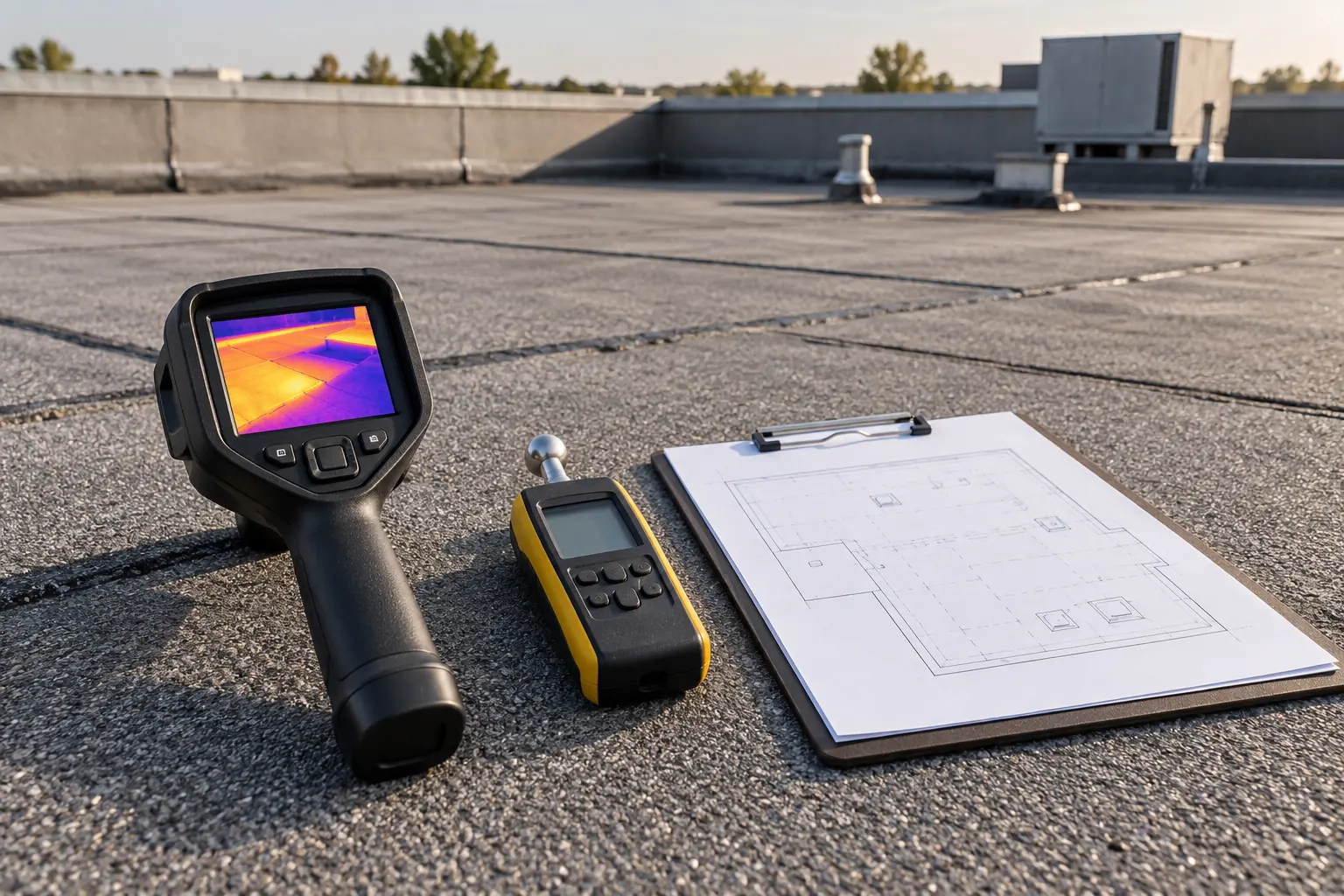
Hero image: AI-generated editorial illustration, not a Rain Guard Roofs customer project.
Why Flat Roof Leak Detection Is Harder Than Following a Stain
A ceiling stain identifies where water became visible, not necessarily where it entered. On a low-slope roof, water can move between the membrane, insulation, deck, and other interfaces before reaching an opening below. That path may cross a room boundary or follow a support before appearing inside.
This makes a patch directly above the stain a hypothesis rather than a diagnosis. The opening may be at a seam, curb, penetration, parapet, drain, or wall transition elsewhere. Water from equipment or condensation may also resemble roof leakage, so the investigation should test the suspected source instead of assuming one.
An inspection needs fixed references that connect the interior and roof plans. Record room locations, equipment positions, roof drains, and building edges together. An unlabeled close photograph of a defect is not enough to show whether it relates to the reported interior symptom.
Keep the distinction between an entry point and wet insulation clear. A moisture survey may show where water has accumulated without identifying the exact opening that supplied it. Repair planning should address the entry path and the condition of affected materials as separate questions.
The Inspection Sequence
Begin with the occupant's history. Record when water appeared, which weather or equipment conditions coincided with it, whether it continued after rain, and what repairs preceded it. Preserve photographs with dates and locations, and note whether the symptom is active dripping, dampness, staining, or another observation.
Review the roof's known assembly and maintenance records next. Drawings, installation information, prior survey results, warranties, and alteration records can explain why a detail deserves attention. A new curb or cable route may change the investigation, but timing alone does not prove that the latest trade caused the leak.
Qualified personnel then inspect the interior and roof where access is appropriate. The roof review should cover field membrane, seams, penetrations, drains, curbs, edges, and adjoining walls, with particular attention to locations suggested by the history. Owners and tenants should not climb onto the roof to trace water themselves.
Map observations before selecting tests. Mark visible openings, ponding, repairs, surface damage, suspect flashing, and equipment water sources separately. A plan helps the surveyor explain why a particular test covers one area and why another area remains outside the investigation.
Testing should answer a defined question: is a layer wet, is a detail open, or can a controlled method reproduce entry? Confirm that the method fits the assembly and available conditions. Specialist services offered by Rain Guard Roofs remain [OWNER: confirm available leak-survey methods and equipment].
Infrared Scanning: What It Detects and What It Does Not
Infrared imaging detects surface temperature patterns. Under suitable conditions, wet insulation can behave thermally differently from nearby dry material, producing an anomaly worth investigating. The camera does not see a literal pool through the membrane, and a colored image alone does not identify the exact hole.
The IIBEC moisture-survey explanation describes thermal anomalies and verification of questionable areas. Roof construction, surface conditions, equipment, and the timing of heat gain and cooling affect interpretation. The survey plan should state whether the roof is suitable and how suspected moisture will be corroborated.
Ask what the operator did when a temperature pattern could have another explanation. Shade, repairs, thickness changes, equipment, and different surfacing can complicate an image. Label anomalies as suspected until supporting evidence justifies a moisture finding, and record areas that could not be evaluated.
If conditions do not support a meaningful scan, the report should say so. A rescheduled survey or another suitable method may be more useful than a dramatic image with uncertain interpretation. Equipment ownership, operator qualifications, and availability are project questions, not capabilities this article assigns to the company.
Moisture Meter Scanning: What the Reading Means
Non-destructive electrical moisture methods respond to properties associated with moisture in the roof assembly. They can help map relative anomalies when the instrument and technique fit the materials. Readings are not a universal percentage of wet insulation, and they do not automatically reveal the membrane's entry point.
Metal, conductive components, assembly changes, and surface conditions can affect interpretation. The operator should establish comparison areas and record the method, equipment settings, and limitations. A numerical display without a documented basis is weak evidence for deciding the boundaries of removal.
Combine appropriate scan results with visual findings and selected verification. The important question is whether several observations support the same conclusion, not whether one instrument produced a high number. If methods disagree, identify the uncertainty and the next test that can resolve it.
Moisture mapping can support a targeted repair or replacement plan. It should not be used to claim that every unmarked area is guaranteed dry unless the method and verification justify that statement. Discuss the implications for flat and low-slope roofing before committing to a recover or coating scope.
Choose Tests Around the Question
The table separates the tools' purposes and limits. A qualified surveyor should select a combination appropriate to the actual roof and the decision being made. Broad descriptions do not replace the operator's procedure or the building's safety and access planning.
| Method | Useful question | Important limitation | Evidence to retain |
|---|---|---|---|
| Visual detail inspection | Is a seam, flashing, drain, or transition visibly defective? | Cannot establish concealed moisture by appearance alone | Located photographs and observations |
| Infrared scan | Are there thermal anomalies consistent with wet layers? | Depends on suitable conditions and assembly interpretation | Thermal images, plan, conditions, and verification |
| Electrical moisture scan | Where do relative readings differ across a suitable assembly? | Materials and conductive layers can affect readings | Grid or route, equipment data, and comparison readings |
| Core sampling | What layers and moisture are present at a selected point? | A local sample does not prove the whole roof condition | Sample location, findings, photographs, and repair record |
| Controlled source testing | Can a suspected detail reproduce observed entry? | Needs a suitable professional procedure and damage controls | Test sequence, observations, and exclusions |
Core Sampling and When It Is Justified
A core sample opens a selected area to identify the roof layers and examine local conditions. It may help confirm a suspected wet zone, explain an unexpected reading, or establish the assembly before planning work. Opening an otherwise intact roof needs a clear decision purpose and an agreed restoration detail.
Choose locations from the survey plan rather than sampling only the most convenient corner. Compare suspect and reference areas where that helps answer the question. Record why each location was selected and what can reasonably be concluded from a local observation.
Obtain owner authorization and coordinate with the issued warranty and suitable personnel. Sampling, access, material handling, and any applicable approval or safety conditions are [VERIFY: current requirement]. This is professional investigative work, not a suggestion that a manager cut into a roof to check whether insulation feels wet.
Restore the opening with a compatible detail and document the completed repair. The report should include the sample location, observed layers, moisture findings, and photographs before and after restoration. Keep retained samples or laboratory information where the survey scope calls for them.
Do not extrapolate one dry core across a broad untested area. Conversely, one wet core does not establish that every layer across the building must be removed. Use the sample with the scan pattern, assembly changes, and other findings to explain proposed work boundaries.
What a Proper Survey Report Should Contain
The report should identify the property, roof areas, dates, personnel, methods, and investigation purpose. State the known assembly and how that information was obtained. Include relevant weather and surface conditions so another professional can assess whether the testing context supported the conclusions.
Provide a roof plan with fixed references, inspection routes or grids, photographs, scan anomalies, verification points, and sample locations. Distinguish observed defects from suspected moisture and confirmed local findings. Do not merge every item into a single red zone that obscures the evidence.
Describe inaccessible areas and method limitations in ordinary language. A manager needs to know whether equipment, overlying materials, weather, or occupied-space restrictions left important questions open. The report should also identify additional work needed before choosing a permanent scope.
Recommendations should connect each proposed action to a finding. Separate urgent protection, focused repairs, further investigation, removal of affected materials, and possible replacement. Give the owner enough detail to compare proposals for roof repair in Northern Virginia without treating a contractor's total as the diagnosis.
Keep the report and completed work record linked. Later observations should show whether the original symptom returned and whether the repaired location changed. That continuity lets the next investigation start with evidence rather than repeat the same inspection without knowing what was already tested.
Why Chasing a Leak Without a Survey Wastes Money
Repeated patches can spend money without narrowing the cause. If each visit applies sealant above the stain, the actual breach may remain elsewhere and concealed moisture may continue to spread. A patch can stop a symptom temporarily without explaining the water route or addressing damaged layers.
A survey is not mandatory for every obvious, isolated defect. The value increases when leaks recur, multiple sources are plausible, or concealed moisture affects the scope. Ask what additional evidence the investigation will produce and how that evidence changes the repair decision.
Compare diagnostic work and repair work as separate line items. Actual survey and repair prices remain [OWNER: figure needed]. This avoids inventing a saving percentage and lets the owner decide whether the proposed investigation resolves an uncertainty that could otherwise lead to repeated work.
For an occupied property, include the operational consequences of testing. Coordinate interior access, equipment activity, sampling, and any controlled water procedure with management. A useful commercial roofing plan protects the building while evidence is gathered; it does not create a new exposure to prove the old one.
Use the Findings to Select the Next Step
Review whether the roof has a repairable entry detail, localized affected layers, broad deterioration, or an unresolved non-roof source. A coating proposal should explain why the substrate is suitable before roof coating systems are considered. Covering a wet assembly does not resolve the reason it became wet.
Agree how the completed repair will be reviewed and what observations should trigger another visit. Keep occupant reports tied to dates and weather rather than declaring success only because the ceiling looked dry on installation day. A defensible conclusion states what was found, what was repaired, and what uncertainty remains.
Frequently Asked Questions
Why is the leak not directly above the ceiling stain?
The entry point may be elsewhere because water can travel laterally within the roof assembly before reaching an interior opening. Map the stain against roof details and the building layout, then investigate plausible paths. The stain helps locate a symptom; it does not by itself establish which membrane detail needs repair.
Can an infrared camera find every flat roof leak?
An infrared camera cannot find every leak. It detects temperature patterns that may indicate wet roof layers under suitable conditions, rather than seeing a hole through the membrane. Roof construction and surface conditions affect results, so suspected areas need supporting observations or verification and the report should state its limitations.
Will a moisture survey always require cutting the roof?
A moisture survey does not always require cutting the roof. Appropriate non-destructive methods may answer some questions, while selected core samples can verify layers or local moisture when justified. Agree authorization, warranty coordination, sampling locations, and compatible restoration in advance; applicable access and procedure conditions remain [VERIFY: current requirement].