Documented maintenance protects a decision record
A commercial roof maintenance checklist gives a property manager a repeatable way to track an asset that is easy to overlook. A roof can have blocked drainage, damaged details, or trade-related punctures before occupants report a leak. Records make it possible to compare changes and assign repairs. They also help the next manager understand what was observed and what was done.
Manufacturer documents often include maintenance responsibilities, but do not assume every warranty has identical terms. GAF’s scheduled-maintenance guide says maintenance is required under many roof guarantees and directs owners to their specific coverage. Carlisle’s Continu-Care program uses annual inspections for its particular maintenance arrangement. These examples support reading the actual document rather than claiming all roofs follow one rule.
Keep the warranty, installation records, inspection reports, and repair invoices together. Neglect can create coverage disputes or leave excluded conditions unaddressed, but this article cannot decide coverage for a building. Ask the issuer to clarify reporting, repair authorization, inspection frequency, and accepted contractors. [OWNER: actual building warranty and maintenance requirements].
Set a twice-yearly baseline and add event-driven checks
Use spring and fall as the starting calendar for this checklist, with adjustments for the actual roof system, building use, and warranty. GAF’s maintenance guide describes twice-yearly inspection as an optimal routine. The table is a practical baseline, not a universal manufacturer requirement. An issued warranty or site-specific plan may call for a different schedule.
Add review after severe weather, new leakage, or rooftop equipment work. Record when a check could not be completed and why. A scheduled task marked postponed should have an assigned next step. Do not close it simply because the calendar month has passed.
Coordinate commercial roof maintenance services around the actual building and accepted scope. [OWNER: confirm service availability, inspection scope, and any maintenance agreement]. The checklist does not establish that a particular visit, report, or repair is included in a contract.
Use qualified personnel and an access plan
Property managers should not climb onto a roof to complete this document. Arrange assessment by qualified personnel working under a suitable access and safety plan. Identify roof hatches, fragile surfaces, openings, edges, and equipment hazards before the visit. [VERIFY: current workplace and access requirements].
An inaccessible area should be recorded as not inspected.
The manager’s role is to coordinate records, access, tenants, work orders, and follow-up. Technical seam testing, invasive inspection, electrical work, and repairs require the appropriate specialist. Do not substitute a caretaker’s visual pass for a system assessment. Assign responsibility clearly rather than giving every task to whoever happens to be available.
The biannual commercial roof maintenance checklist
Print this sheet for each roof area or building. Record findings on a marked roof plan or numbered photo log and attach those references to the completed sheet. Check frequency against the actual warranty and operating conditions. “Who does it” means the person assigned to arrange or perform qualified work, not permission for untrained roof access.
Commercial roof maintenance field record
Building / roof area: ____________________ Date: ____________________
Qualified inspector: ____________________ Weather: ____________________
Next review: ____________________ Photo / work-order reference: ____________________
| Item | What to look for | Frequency | Who does it |
|---|---|---|---|
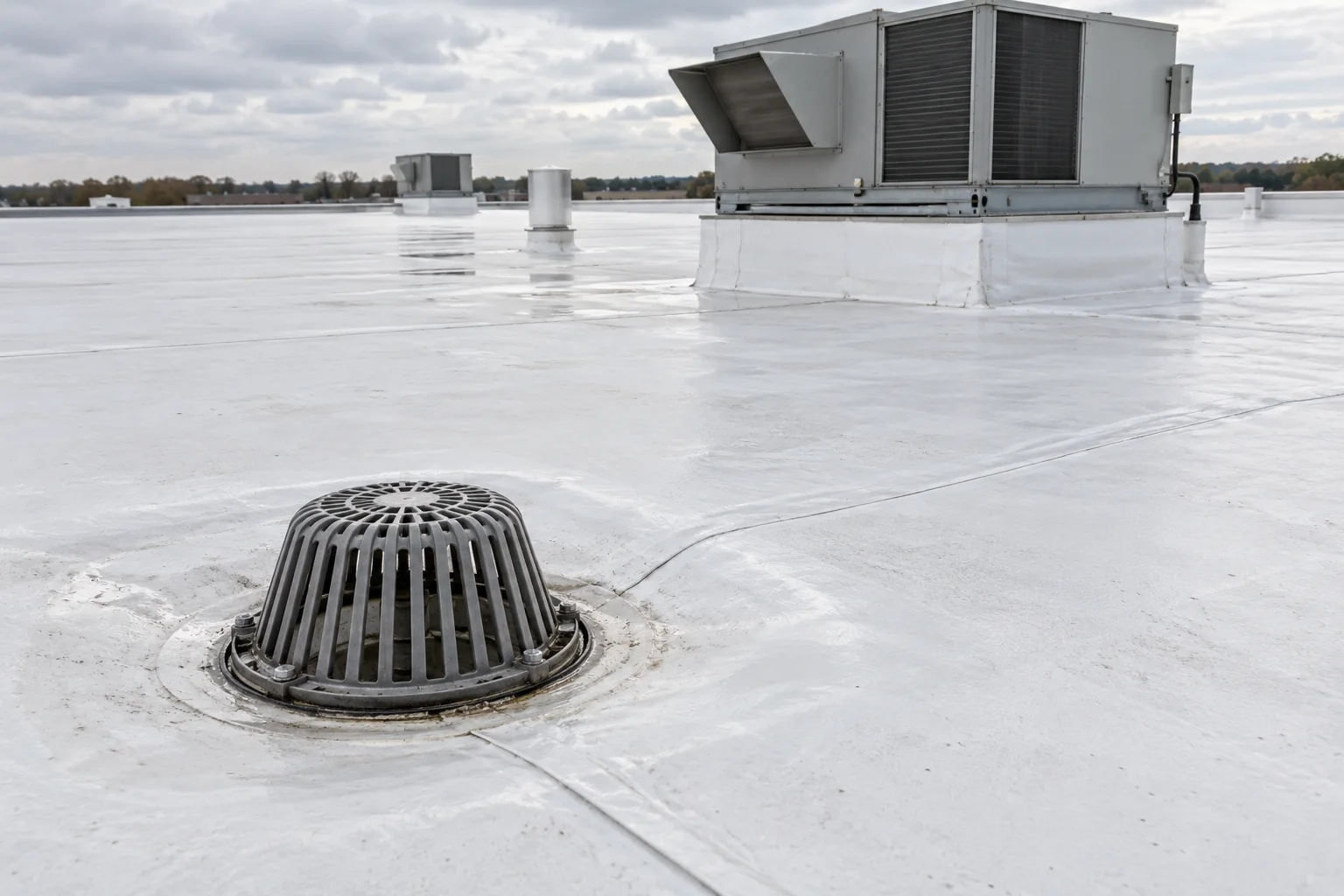
| Drains and scuppers | Debris, missing strainers, damaged connections, restricted discharge | Twice yearly; after storms or observed blockage | Qualified roof/drainage personnel; manager schedules follow-up |
| Seams | Visible openings, lifting edges, repair changes; specialist assessment as needed | Twice yearly and after damage concerns | Qualified roofing professional |
| Flashing | Loose terminations, splits, movement, failed wall or curb connections | Twice yearly and after reported leakage | Qualified roofing professional |
| Penetration seals | Cracking, gaps, displaced components, incompatible previous repairs | Twice yearly; after new penetration work | Roofing professional with relevant equipment trade |
| Ponding assessment | Standing-water locations, drainage path, weather and observation timing | Twice yearly; after drainage complaints | Roofing/drainage professional; manager retains event record |
| Membrane surface | Punctures, abrasion, contamination, blisters, or changed repair areas | Twice yearly; after rooftop trade work | Qualified roofing professional |
| Edge metal | Loose, displaced, corroded, or damaged perimeter components | Twice yearly and after wind events | Qualified roofing professional |
| Equipment curbs | Flashings, movement, leaks, overflow, nearby service damage | Twice yearly; after equipment servicing | Roofing professional plus responsible equipment contractor |
| Safety items | Access condition, identified openings, damaged walkways, unresolved hazards | Before each authorized visit; formal review per site plan | Qualified safety/access personnel; manager coordinates |
Finding / location: ____________________________________________________
Assigned action / owner: ________________________________________________
Target date / completion evidence: _______________________________________
No untrained roof access. Confirm actual warranty and safety requirements. Record inaccessible areas as not inspected.
Drainage observations need context
A photograph of standing water does not by itself establish the duration, depth, cause, or system consequence. Record the observation time, recent weather, drain condition, and roof area. Compare it with prior records. Ask a professional whether the finding needs cleaning, drainage investigation, or a broader survey.
Do not invent a universal allowable ponding period or treat a single dry-weather observation as proof of good drainage. Product instructions, roof design, and building conditions matter. [VERIFY: current requirement where drainage or design review applies]. A repeat problem deserves investigation even if occupants have not yet reported interior water.
Seams, flashings, and penetrations need system-specific review
A visible defect at a seam or curb can be a useful warning without identifying the full extent of moisture below. Qualified inspection should distinguish an observation from a confirmed failure. Ask the report to identify the membrane and compatible repair approach. Do not request generic sealant over every questionable detail.
Wall flashings and rooftop equipment interfaces also cross trade boundaries. Water may come from masonry, ducts, condensation, or equipment drainage rather than the field membrane. Give the roofing professional the equipment-service history and interior leak locations. Ask who investigates each unresolved interface.
For flat and low-slope roofing, retain detail photographs of terminations, corners, curbs, and repaired sections. Mark them on the roof plan. A sequence of identifiable images is more useful than a folder of close-ups whose locations nobody can explain.
What to document each time
Record the building, roof area, date, weather, inspector, access limitations, and the method used. Label observations as satisfactory, action needed, not applicable, or not inspected. Do not turn “not seen” into “no defect.” Link each concern to a photograph, roof-plan location, and work-order reference.
For each action, assign an owner and a target date, then record the completed work and evidence. A photograph of the defect is not proof of repair. Retain the contractor’s description, product information, invoice, and completion image. If the action changes after investigation, preserve the original finding and explain the new decision.
Keep manufacturer notices and responses with the same record. Use the actual reporting instructions and deadlines in the issued documents. [OWNER: building-specific notice procedures]. Maintenance records support a factual history; they do not replace timely notice or establish that the manufacturer accepts a particular repair.
Track equipment work and tenant alterations
Ask service trades to identify the areas they access and any new penetrations or equipment changes. Review the surrounding roof after work through qualified personnel. Keep the roof contractor and equipment contractor’s responsibilities distinct. A roof leak discovered after service is a reason to investigate, not proof that a particular trade caused it.
Before new equipment is installed, confirm support, flashing, drainage, access paths, and warranty coordination with the responsible advisers. [VERIFY: current design and approval requirements]. Do not treat a tenant’s equipment agreement as a complete roof specification. Record who authorizes changes and maintains the interface afterward.
When to escalate to a professional survey
Escalate recurring leaks, repeated ponding, widespread seam concerns, changing surface condition, or suspected concealed moisture. A targeted repair may address an isolated defect, while an unresolved pattern calls for broader investigation. Ask what question the survey is intended to answer. The proposed method should fit the system and the suspected condition.
A moisture survey may use appropriate tools and selective verification, but a surface image alone does not map all wet insulation. Ask the report to explain its method, limitations, verified findings, and recommended next steps. [OWNER: confirm the exact survey services available]. Do not present an inferred wet area as a measured replacement quantity.
For a capital decision, compare repair, restoration, and replacement using actual condition evidence and project prices. Discuss commercial roofing as the broader system question. A maintenance checklist informs that conversation; it is not a substitute for a scope, engineering review where needed, or a priced proposal.
Close the loop before the next review
Keep an open-action register instead of relying on the next inspection to rediscover the same problem. Review overdue work, missing repair evidence, and unresolved specialist questions with the building team. Update the roof plan after substantial work. The next scheduled visit should begin with the last report and its outstanding actions.
Review roofing warranties explained alongside the actual issued warranty, then keep the building-specific document authoritative. A useful maintenance program produces clear observations, assigned actions, and retained evidence. That is the record a property manager can hand to ownership when discussing the next operating or capital decision.
Give the maintenance file a stable structure
Use consistent roof-area names across the checklist, photographs, contractor reports, and invoices. A changed naming system can make an earlier repair look like a different location. Keep an index of current warranty documents and responsible contacts, with private access details stored separately. A usable handoff should let another manager locate the latest inspection and its open actions without searching through unrelated correspondence.
Manufacturer maintenance references
Frequently Asked Questions
How often should a commercial roof be inspected?
Use twice-yearly reviews as a practical baseline and add checks after severe weather, new leakage, or rooftop trade work. Confirm the actual system’s warranty and maintenance instructions because they may specify a different arrangement. Assign qualified personnel, retain the findings, and document postponed or inaccessible areas instead of marking them complete.
Does completing this checklist guarantee warranty coverage?
No. The checklist helps organize observations and follow-up, but coverage depends on the issued warranty and the actual circumstances. Read its maintenance, notice, repair, and qualification provisions, and ask the issuer to clarify uncertainties. Keep inspection and completion records without treating documentation alone as approval of a repair or claim.
When is a moisture survey more useful than routine maintenance?
A survey may be appropriate when leaks recur, drainage concerns persist, or findings suggest concealed moisture that a routine visual review cannot resolve. Ask a qualified professional to define the question, method, limitations, and verification steps. Use documented findings to choose the next action rather than estimating replacement quantities from surface appearance alone.